
Cloud Infrastructure Vendors in Malaysia: 2026 Local Vendor Guide
Cloud infrastructure decisions in Malaysia now go far beyond choosing a hosting location. Organizations weigh data control, recovery capability, regulatory compliance, AI readiness, and the quality of daily operations support before signing a contract. A low monthly price or a nearby data center looks attractive at first glance, but long-term value becomes clear during audits, outages, and rapid scaling events.
Global hyperscalers support scale, analytics, and AI services well. Local cloud vendors in Malaysia address hosted workloads, backup, recovery, compliance evidence, and support escalation for organizations that need more direct control over regulated systems.
What BNM RMiT Means for Cloud Infrastructure Vendors
Bank Negara Malaysia’s Risk Management in Technology (RMiT) sets the main technology risk standard for financial institutions in Malaysia. RMiT remains the primary technology risk framework governing financial institutions in Malaysia, with continued emphasis on technology governance, cyber resilience, operational availability, and the secure adoption of emerging technologies. For cloud infrastructure, the key message is clear: For cloud infrastructure, the key message is clear: outsourcing infrastructure does not outsource accountability. Financial institutions remain responsible for managing technology risks, even when critical workloads are hosted on third-party platforms.
For cloud vendor selection, RMiT makes five areas especially important: board-level governance, data sovereignty, operational resilience, cybersecurity controls, and cloud risk assessment. This means a vendor should support clear audit evidence, documented exit planning, secure access control, disaster recovery testing, service availability reporting, SIEM integration, vulnerability management, and contractual audit rights. Public cloud adoption for critical systems also requires stronger risk assessment around multi-tenancy, data localization, shared responsibility, and provider exit strategy.
Local cloud infrastructure vendors become relevant when they help reduce operational uncertainty around data location, support escalation, recovery planning, and compliance documentation. On-premises, Malaysia-hosted private cloud, and governed hybrid cloud models often give regulated organizations clearer control over customer data, access logs, backup copies, and recovery processes.
Where Wiki Labs Sdn Bhd Fits in RMiT Readiness
Organisations evaluating cloud infrastructure providers for regulated environments should be cautious of vendors claiming direct “RMiT compliance.” RMiT places accountability on the financial institution, not the technology provider. The more important question is whether a vendor can support the governance, visibility, resilience, and operational evidence required for ongoing compliance obligations.
In this context, Wiki Labs Sdn Bhd positions itself as an enabler of RMiT readiness through WikiBlox, hybrid cloud architecture, cybersecurity, data protection, observability, and managed operations services. These capabilities help organisations strengthen control over infrastructure, improve operational resilience, and produce the evidence often required during audits and risk reviews.
Local Cloud Infrastructure Vendors in Malaysia: Profiles and Fit
Wiki Labs Sdn Bhd

Wiki Labs Sdn Bhd is a local hybrid cloud and infrastructure modernization specialist. Its work covers hybrid cloud design, cybersecurity, data protection, business continuity, observability, automation, and AI-ready infrastructure planning.
WikiBlox is its key platform for Malaysian enterprises that need virtualization, containers, SOE governance, and managed operations in one environment. It is relevant for organizations modernizing legacy workloads, reducing VMware dependency, and improving control across hybrid cloud operations.
For regulated sectors, Wiki Labs Sdn Bhd supports organisations in strengthening operational controls and producing the evidence often required for RMiT-related governance and risk management activities. This includes areas such as data control, access visibility, recovery planning, and Day 2 operational management.
AVM Cloud
AVM Cloud focuses on enterprise cloud, IaaS, DRaaS, and VMware-aligned environments. It suits organizations with VM-heavy workloads, private cloud needs, and disaster recovery requirements.
Its key fit is infrastructure reliability and recovery support. Regulated organisations should assess its modernisation roadmap, container readiness, and documented RPO and RTO commitments.
Exabytes
Exabytes provides private cloud, managed hosting, backup, secured connectivity, disaster recovery, and business infrastructure support. It suits SMEs and mid-market organizations that need hosted infrastructure with local support.
Its key fit is reliable managed hosting and private cloud. Regulated organisations should assess recovery testing, compliance evidence, security operations maturity, and support scope.
Shinjiru

Shinjiru offers web hosting, VPS, dedicated servers, cloud hosting, and Microsoft-aligned solutions. It suits SMEs, web applications, dedicated hosting users, and businesses moving from basic hosting into structured cloud hosting.
Its key fit is web infrastructure and managed server environments. Regulated organisations should assess backup design, security controls, and recovery commitments before using it for production systems.
TrueCloud Solutions
TrueCloud Solutions provides cloud servers, development and testing environments, cloud backup, IaaS, and disaster recovery planning. It suits smaller organizations that need cloud infrastructure without owning physical hardware.
Its key fit is cost-effective cloud adoption for SMEs seeking infrastructure flexibility without significant upfront investment. Regulated organisations should assess monitoring maturity, security hardening, scalability, and compliance reporting before using it for sensitive workloads.
Cloud Infrastructure Vendors in Malaysia: Five Criteria for Regulated Workloads
Cloud Infrastructure Vendors in Malaysia often promote local data centers, sovereign cloud, and support availability. These points matter, but regulated workloads need a deeper review. A stronger assessment should look at who manages access, backup, recovery, compliance evidence, incident response, cost visibility, and migration options after deployment.
The table below provides a high-level view of selected local infrastructure vendors by deployment model and typical use case. It is not intended as a ranking or certification of compliance. Organizations should validate each vendor’s technical controls, contractual commitments, recovery processes, audit support, and operational governance against their own regulatory and business requirements.
Organizations modernizing regulated infrastructure often need more than hosting capacity. They need platforms that support control, visibility, recovery, and governance. WikiBlox is positioned for this type of environment through hybrid cloud deployment, virtual machine and container support, observability, cybersecurity, managed operations, and governance capabilities.
For lower-risk workloads, managed hosting, VPS, private cloud, or general IaaS may be suitable depending on the application and data sensitivity. Regulated sectors such as financial services, healthcare, and government-linked entities usually require stronger focus on data control, recovery planning, access visibility, compliance evidence, and long-term platform governance.
How to Evaluate Any Local Cloud Vendor Against RMiT Requirements
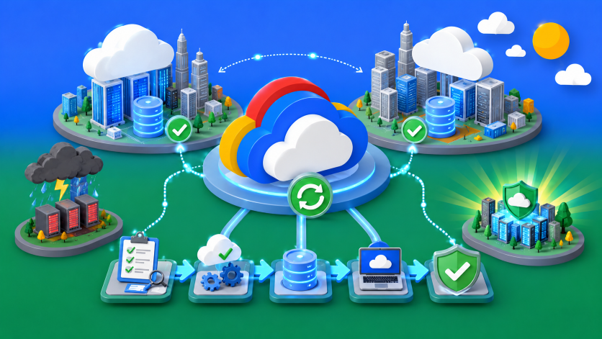
Financial institutions and regulated businesses should assess cloud vendors through five practical checks:
Data location and control
Confirm where production data, backups, replicas, and monitoring telemetry reside. A vendor may host workloads in Malaysia but still route management traffic through overseas systems. On-premises or Malaysia-hosted control planes give clearer data residency control.Exit strategy and audit access
Check whether the contract includes a documented exit plan and regulator audit access. The organization should be able to migrate away without losing data access or operational continuity. The vendor should also provide logs, recovery records, and operational evidence when needed.Built-in security evidence
Assess whether security controls are built into the platform or added separately. Firewalls, access logging, SIEM integration, anomaly monitoring, intrusion detection, and vulnerability management should produce evidence for audit reviews.Recovery testing and resilience
Review documented RPO and RTO targets, backup restoration evidence, disaster recovery procedures, and recovery test results. Recovery capability should be tested before deployment, not accepted only from service descriptions.Local support and escalation
Confirm who owns support, incident response, and escalation in Malaysia. Regulated workloads need fast response, clear accountability, and structured Day 2 operations that align with compliance and reporting obligations.
On Premises vs Hybrid vs Public Cloud: Which Model Fits RMiT Best
On-premises infrastructure gives the clearest control for regulated workloads because data, access, recovery, and operations remain within the organization’s environment. It reduces cloud risk exposure, but it also requires stronger internal ownership for hardware, refresh cycles, monitoring, and resilience.
Hybrid cloud gives more flexibility by combining controlled local infrastructure with selected cloud services. It fits organizations that need to keep sensitive systems close while still using cloud-connected services for backup, analytics, scaling, or modern applications. The key requirement is proper documentation for data location, multi-tenancy controls, recovery design, and exit planning.
Public clouds can support innovation, analytics, and non-critical workloads, but critical systems need stronger governance, risk assessment, and regulatory consultation before deployment. For RMiT-aligned environments, the strongest model is usually the one that matches workload sensitivity. Core regulated workloads often require greater control over data, access, and recovery, making on-premises or governed hybrid cloud models common choices. Lower-risk workloads may be well suited to public cloud environments when appropriate governance and security controls are in place.
WikiBlox: Malaysia’s Modern Approach to VMware Migration Alternative Service Providers Malaysia
WikiBlox delivers a modern virtualisation foundation designed specifically for Malaysian enterprises. It unifies virtual machine and container workloads within a single platform, simplifying management, migration, and scalability.
Built around strong governance and local compliance frameworks, WikiBlox helps organisations modernise their IT environments confidently. For enterprises evaluating VMware alternatives, it provides a future-ready platform developed and supported within Malaysia.
WikiBlox: What You Should Know
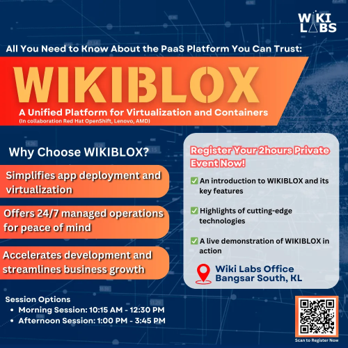
WikiBlox by Wiki Labs Sdn Bhd is engineered on an enterprise-grade architecture that integrates Red Hat OpenShift with Lenovo infrastructure powered by AMD EPYC processors, all operated within Malaysia. The platform unifies virtual-machine and container workloads under managed operations with built-in governance, security, and compliance aligned to Malaysian enterprise standards.
A recent local deployment within the financial services sector demonstrated significantly faster provisioning and measurable cost efficiencies compared with traditional virtualisation environments. For organisations exploring VMware alternatives, WikiBlox distinguishes itself through local support, regulatory alignment, and optimisation for hybrid-cloud and container workloads.
How Wiki Labs Helps Manage Virtualisation Costs
Wiki Labs provides full-lifecycle services for enterprise virtualisation — from assessing existing VMware environments to designing migration frameworks and optimising operations post-deployment.
Through cost-transparency analysis, predictable licensing models, and Malaysia-based support, Wiki Labs helps organisations identify and reduce hidden expenses associated with legacy systems. Its consultants offer clear insights into the total cost of ownership (TCO) across leading VMware alternatives, ensuring each client selects the most cost-effective and scalable approach for long-term growth.
With deep local expertise and platform-agnostic hardware integration, Wiki Labs enables Malaysian enterprises to achieve operational clarity and sustainable cost efficiency in their modernisation journey.
Ready to Move Forward with Modern VMware Alternatives?
WikiBlox isn’t just another platform. It’s your all-in-one foundation for Malaysia’s enterprise IT future.
👉 Schedule a free consultation with Wiki Labs experts today to see how WikiBlox can power your transformation.
Disclaimer:
The information in this article is provided for general informational purposes only. All product names, trademarks, and registered trademarks are the property of their respective owners. References to third-party technologies such as VMware, Red Hat, Lenovo, AMD, and others are made solely to describe compatibility or comparison context and do not imply any endorsement or affiliation.
Wiki Labs Sdn Bhd makes reasonable efforts to ensure the accuracy of information at the time of publication; however, readers are encouraged to verify technical details and licensing information directly with the respective vendors.
