Cost of VMware Migration Services in Malaysia | Enterprise Cost Breakdown
The cost of VMware migration services in Malaysia has become a bigger issue than many enterprises expected. What once looked like a routine infrastructure decision now affects renewal budgets, migration spending, and long-term operating costs at the same time. For enterprise teams in Malaysia, the real question is no longer whether VMware costs more, but how to judge the full financial impact before the next contract, migration plan, or platform decision moves forward.
Cost of VMware Migration Services: Executive Summary for Malaysian Enterprises
The cost of VMware migration services in Malaysia now extends far beyond project delivery fees alone. Enterprise infrastructure planning must account for VMware licensing changes, assessment and discovery activities, migration execution, testing, temporary overlap between legacy and new environments, decommissioning efforts, and long-term operational expenses after migration.
Many enterprise modernization frameworks today emphasise migration assessment and total cost of ownership (TCO) planning as part of infrastructure transformation. This reflects a broader industry understanding that a migration quotation alone rarely represents the full financial impact of platform decisions.
For Malaysian enterprises, the primary budgeting challenge is no longer simply the migration exercise itself. The bigger strategic question is whether remaining on VMware, optimising the current environment, or transitioning to an alternative platform delivers the strongest operational and financial outcome over the next three to five years.
A disciplined enterprise decision therefore begins with cost separation. Teams should clearly isolate VMware renewal costs, migration project costs, temporary transition overheads, and long-term operating expenses after migration. Once these financial components become visible, VMware migration services can be evaluated more effectively as part of a broader infrastructure business case rather than a single procurement exercise.
Why Has VMware Migration Services Pricing Changed?
Broadcom changed the licensing economics
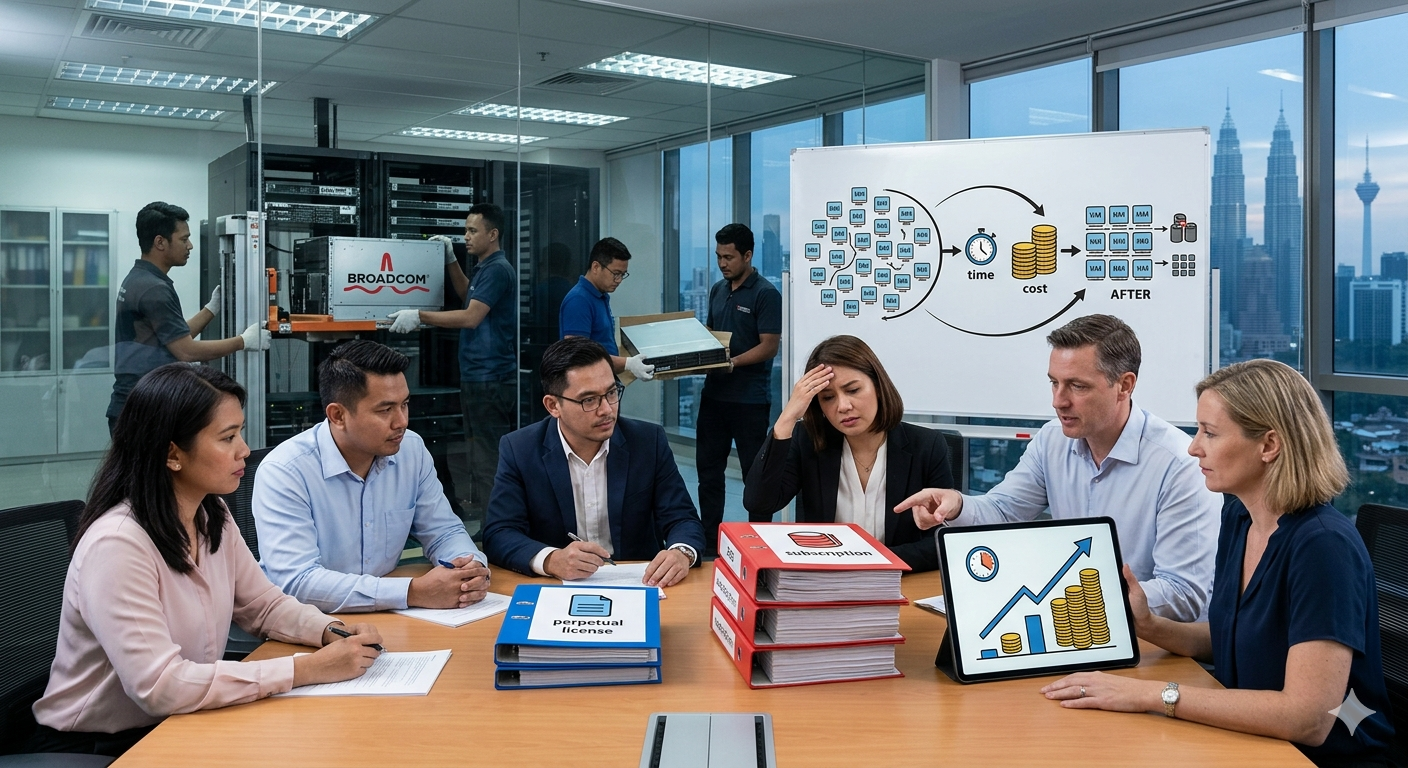
The cost of VMware migration services became a larger enterprise issue after Broadcom changed the VMware commercial model. Broadcom’s current VMware Cloud Foundation program documentation states that the software is licensed on a per-core subscription basis, with a minimum of 16 core licenses per processor. That change matters because infrastructure budgets now move with server core counts, bundle selection, and renewal structure, which directly affects cost planning during hardware refresh, contract renewal, and platform redesign.
The broader market response also explains why migration spending now receives more board-level attention. Reuters reported that the European Commission asked Broadcom for information after complaints from business users and trade groups about VMware licensing changes, including higher prices, rebundled products, and altered conditions for customers using perpetual licenses.
As a result, many enterprises no longer assess VMware renewal as a stand-alone software decision. They now compare the cost of staying on VMware against the cost of VMware migration services, the cost of temporary overlap during transition, and the long-term cost of operating an alternative platform. That shift explains why migration projects are now framed less as one-time infrastructure moves and more as multiyear financial and operating model decisions.
Local budgeting pressure
In Malaysia, these licensing changes have created additional pressure on enterprise infrastructure budgeting. Some organisations have reported significantly higher renewal costs following the Broadcom transition, particularly when reassessing subscription structures, bundled platform components, and long-term capacity planning.
This has shifted virtualization discussions beyond software pricing alone. Enterprises are increasingly evaluating how licensing models, infrastructure growth, and operational requirements influence long-term total cost of ownership during both renewal cycles and platform modernization initiatives.
From the migration perspective, local enterprise projects are also becoming more structured and operationally focused. Many organizations now prioritize readiness assessments, phased migration approaches, governance alignment, operational continuity, and post-migration optimization as part of broader infrastructure transformation programs.
This shift is important because enterprise migration is no longer viewed as a simple workload relocation exercise. Instead, it is increasingly managed as a controlled transition program shaped by compliance requirements, operational stability, support readiness, and long-term platform governance.
As a result, enterprise teams in Malaysia now require stronger business justification before committing to either renewal or migration strategies. The key consideration is no longer limited to software pricing alone, but whether the combined impact of licensing, migration investment, transition overheads, governance controls, and steady-state operations delivers a stronger long-term outcome for the organization.
Cost of VMware Migration Services: Uncovered Main Budget Components
Engineering effort and tool costs
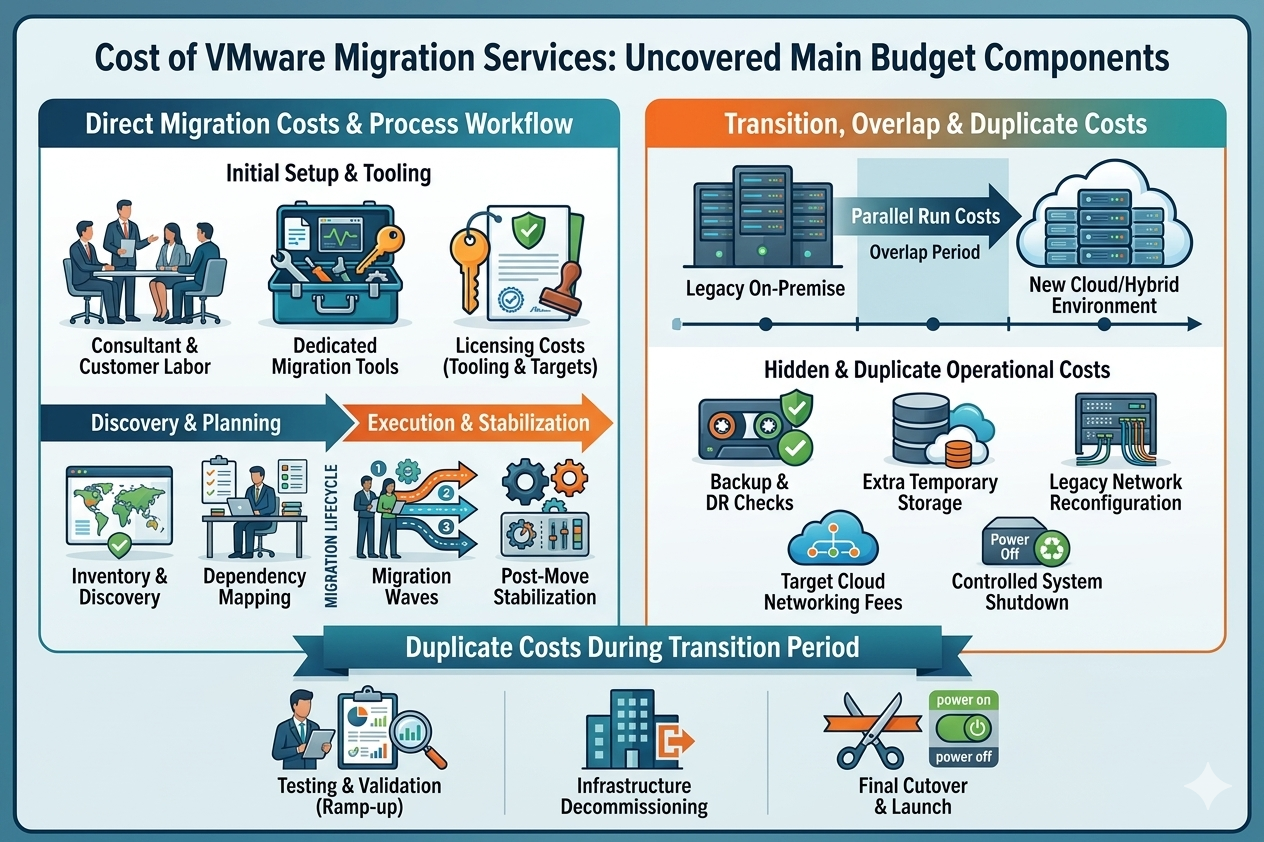
The cost of VMware migration services increases significantly due to engineering effort. Based on AWS, migration assessments should account for customer person-days, partner person-days, partner cost rates, migration tool costs, software licenses, and ongoing software maintenance. Industry analysis suggests that reducing labor, shortening timelines, lowering service dependency, and minimizing operational risk all lead to lower migration costs. These factors demonstrate that labor and project duration are key drivers of cost.
To effectively budget for VMware migration, enterprises should separate discovery work from execution work. Discovery involves inventory, dependency mapping, and target state planning. Execution covers migration waves, validation, post-move fixes, and stabilization. Bundling these into a single line item makes it harder to compare quotes and understand where costs could rise during the project.
Overlap, Testing, and Decommissioning
Another key budget component is the overlap period between old and new environments. AWS recommends ramping up new environment costs during migration while simultaneously reducing costs for the existing infrastructure. This ensures proper testing and decommissioning while avoiding unnecessary downtime.
During this overlap, additional costs often arise from backup checks, disaster recovery alignment, extra storage, network changes, and staff time required for system shutdown. A well-planned business case should clearly separate VMware renewal costs, project services costs, and steady-state operating costs post-migration. This helps businesses account for costs during the migration and plan for future operational efficiency.
Cost of VMware Migration Services: Cost Breakdown in Malaysia 2026
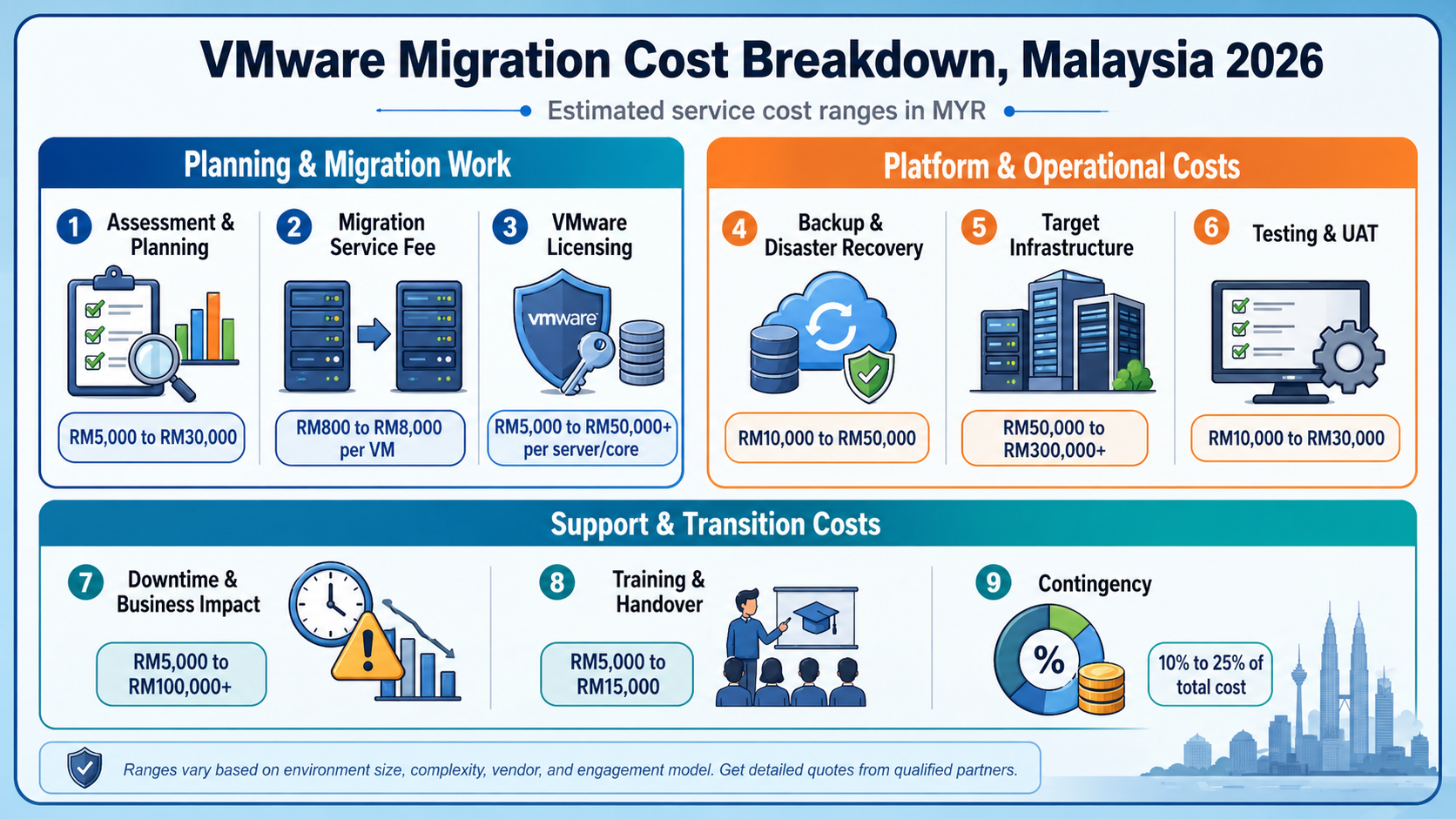
In 2026, the cost of VMware migration services in Malaysia varies significantly depending on workload volume, virtualization architecture, operational complexity, migration scope, and governance requirements. Small-scale upgrade projects involving limited infrastructure changes may require relatively modest investment, while enterprise-scale migration initiatives involving large virtual machine estates, multi-site environments, high availability requirements, and phased transition planning can become substantially more complex.
Migration budgets are also influenced by factors such as assessment activities, dependency mapping, migration tooling, testing requirements, operational overlap periods, compliance considerations, and post-migration support expectations.
For this reason, enterprise organizations should avoid evaluating migration services based solely on headline project pricing. A more effective approach is to assess the full operational scope, long-term infrastructure objectives, and steady-state operating model before finalizing migration investment decisions.
Enterprise VMware Migration Budget Planning Framework
Estimating the cost of VMware migration services requires more than calculating a single project fee. Enterprise migration initiatives typically involve multiple operational, infrastructure, governance, and transition-related components that must be evaluated together as part of a broader modernization strategy.
Rather than focusing only on migration execution costs, enterprise teams should assess the full lifecycle impact of the migration program, including operational continuity, transition planning, licensing considerations, infrastructure readiness, and post-migration operating models.
A structured VMware migration budgeting exercise commonly evaluates the following areas:
Infrastructure assessment and discovery
Dependency mapping and migration planning
Migration engineering and execution activities
VMware or target platform licensing considerations
Backup and disaster recovery alignment
Target infrastructure preparation
Testing, validation, and user acceptance activities
Operational overlap during transition periods
Knowledge transfer and operational readiness
Governance, compliance, and contingency planning
Example Enterprise Migration Planning Scenario
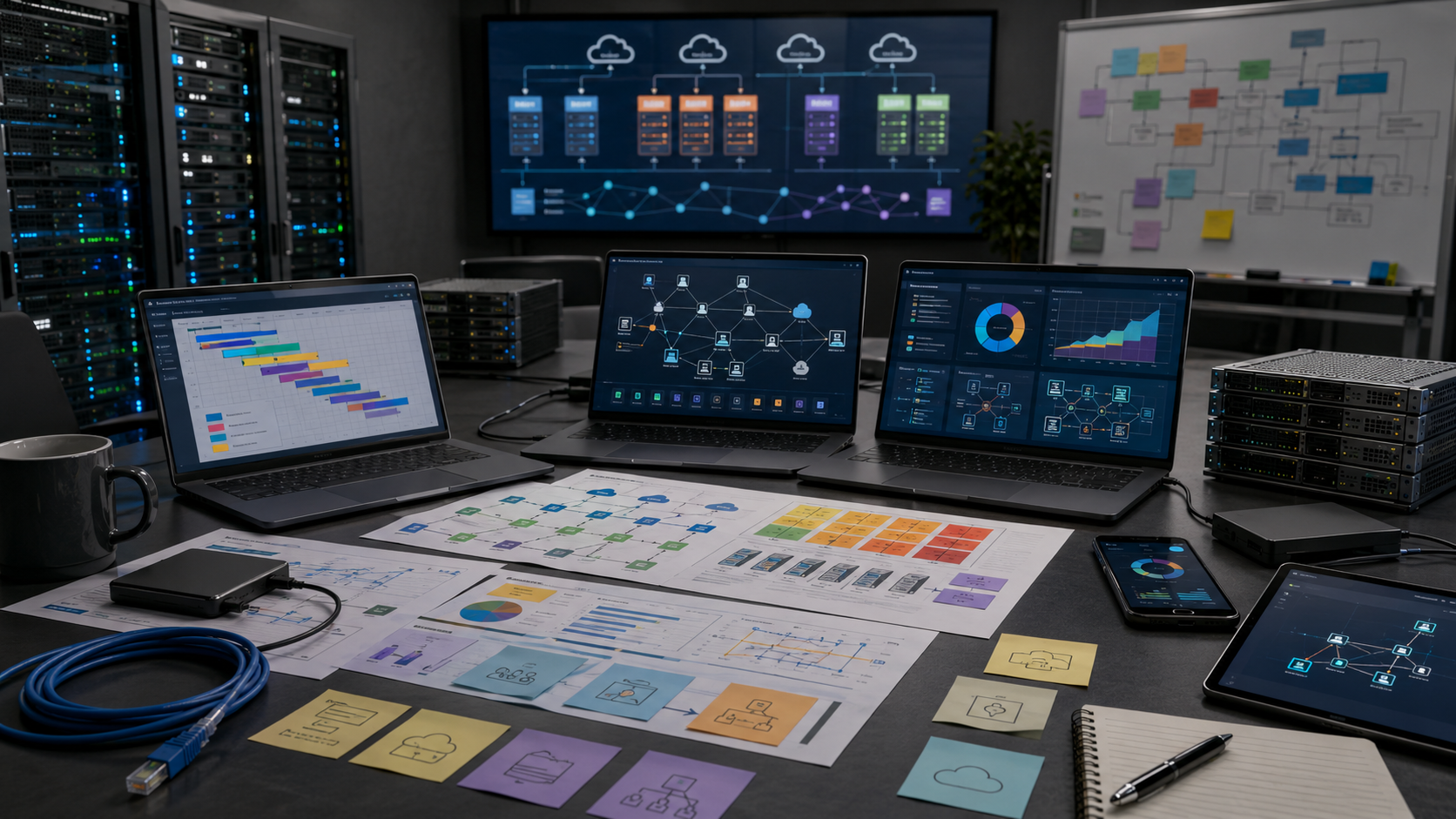
For medium-to-large enterprise environments involving multiple virtualization hosts, migration waves, and operational transition requirements, budgeting exercises are typically structured around migration complexity, workload criticality, operational dependencies, and long-term infrastructure objectives rather than fixed per-VM pricing alone.
This is especially important because enterprise migration costs can vary significantly depending on factors such as:
application dependencies
downtime tolerance
compliance requirements
disaster recovery architecture
migration methodology
operational support requirements
target platform design
phased versus full migration approaches
As a result, enterprise organizations should avoid evaluating VMware migration projects purely as procurement exercises based on a single quotation. A more effective approach is to assess the migration as part of a longer-term infrastructure modernization and operational governance strategy.
Malaysia-Specific Enterprise Considerations
In Malaysia, enterprise VMware migration planning also requires consideration of local operational and commercial factors, including:
regulatory and compliance expectations
operational support availability
managed services requirements
infrastructure hosting models
taxation and procurement structures
long-term subscription and operating costs
Many Malaysian enterprises are therefore placing greater emphasis on phased migration planning, operational governance, infrastructure visibility, and post-migration optimization as part of their modernization initiatives. This aligns closely with broader enterprise infrastructure strategies focused on stability, scalability, and long-term operational sustainability.
From Migration Cost to 3-Year Infrastructure Planning
The initial cost breakdown provides a useful starting point for VMware migration planning. However, enterprise infrastructure decisions should extend beyond the immediate project investment and evaluate how operational, licensing, and platform costs evolve over a longer-term planning horizon.
Post-migration financial planning often includes ongoing subscription and renewal considerations, infrastructure operating costs, support requirements, and future scalability planning. Under newer subscription-based licensing models, factors such as infrastructure size, hardware architecture, bundled platform components, and server core counts can materially influence long-term expenditure.
For this reason, enterprise organizations increasingly evaluate migration initiatives through a three-year operational and financial lens rather than focusing solely on upfront project costs. A lower initial migration investment does not always result in a lower long-term operating model.
By assessing migration planning, renewal structures, infrastructure growth, operational support requirements, and governance considerations together, enterprises can develop a clearer understanding of the broader financial and operational commitment involved in platform modernization.
Cost of VMware Migration Services: Why a 3-Year Cost View Matters

In Malaysia, the cost of VMware migration services is increasingly evaluated through a longer-term operational and financial lens rather than through the initial project quotation alone. Enterprise infrastructure decisions now commonly involve three major cost considerations: platform renewal and subscription costs, migration investment during the transition phase, and long-term operating costs after migration.
Under current subscription-based licensing structures, factors such as physical core counts, infrastructure scale, hardware architecture, and bundled platform components can materially influence renewal expenditure over time. As a result, organizations are placing greater emphasis on understanding how infrastructure growth and operational requirements affect long-term platform sustainability.
This is why a lower upfront migration proposal does not always result in a stronger long-term business outcome. Enterprise migration planning frameworks increasingly evaluate total cost of ownership (TCO), migration timing, operational overlap periods, decommissioning strategy, training requirements, and ongoing support considerations as part of broader infrastructure modernization initiatives.
Recent industry developments also reinforce the importance of long-term planning around virtualization strategy, licensing models, and operational flexibility. For enterprise organizations in Malaysia, VMware migration discussions are therefore becoming less about one-time implementation projects and more about building sustainable infrastructure operating models that support future scalability, governance, and operational resilience.
Conclusion: Enterprise VMware Migration Services Malaysia 2026
The cost of VMware Migration Services in Malaysia now sits at the center of a broader enterprise cost decision. The issue is no longer limited to migration project fees, because licensing pressure, engineering effort, transition overlap, testing, training, and post-migration support all shape the final financial outcome. A sound enterprise decision therefore depends on structured assessment, phased execution, and a clear multi-year view of cost before any renewal or migration path is approved.
The strongest cost position comes from disciplined planning at the start of the program. Clear workload data, realistic overlap assumptions, defined recovery needs, and a firm timeline for legacy shutdown give finance and infrastructure teams a better basis for evaluating options. When those inputs are weak, the cost of VMware migration services becomes harder to predict and easier to underestimate.
For enterprises in Malaysia, the better approach is to compare renewal, optimization, and migration through one business case instead of treating them as separate choices. The cost of VMware Migration Services becomes easier to control when discovery is complete, migration waves are manageable, and decommissioning is planned from the beginning. That approach produces a stronger basis for decision-making, fewer cost surprises during execution, and a clearer long-term operating position.
WikiBlox: Malaysia’s Modern Approach to VMware Migration Alternative Service Providers Malaysia
WikiBlox delivers a modern virtualisation foundation designed specifically for Malaysian enterprises. It unifies virtual machine and container workloads within a single platform, simplifying management, migration, and scalability.
Built around strong governance and local compliance frameworks, WikiBlox helps organisations modernise their IT environments confidently. For enterprises evaluating VMware alternatives, it provides a future-ready platform developed and supported within Malaysia.
WikiBlox: What You Should Know
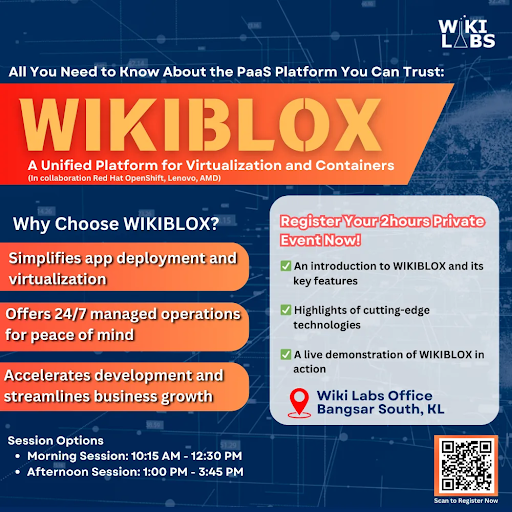
WikiBlox by Wiki Labs Sdn Bhd is engineered on an enterprise-grade architecture that integrates Red Hat OpenShift with Lenovo infrastructure powered by AMD EPYC processors, all operated within Malaysia. The platform unifies virtual-machine and container workloads under managed operations with built-in governance, security, and compliance aligned to Malaysian enterprise standards.
A recent local deployment within the financial services sector demonstrated significantly faster provisioning and measurable cost efficiencies compared with traditional virtualisation environments. For organisations exploring VMware alternatives, WikiBlox distinguishes itself through local support, regulatory alignment, and optimisation for hybrid-cloud and container workloads.
How Wiki Labs Helps Manage Virtualisation Costs
Wiki Labs provides full-lifecycle services for enterprise virtualisation — from assessing existing VMware environments to designing migration frameworks and optimising operations post-deployment.
Through cost-transparency analysis, predictable licensing models, and Malaysia-based support, Wiki Labs helps organisations identify and reduce hidden expenses associated with legacy systems. Its consultants offer clear insights into the total cost of ownership (TCO) across leading VMware alternatives, ensuring each client selects the most cost-effective and scalable approach for long-term growth.
With deep local expertise and platform-agnostic hardware integration, Wiki Labs enables Malaysian enterprises to achieve operational clarity and sustainable cost efficiency in their modernisation journey.
Ready to Move Forward with Modern VMware Alternatives?
WikiBlox isn’t just another platform. It’s your all-in-one foundation for Malaysia’s enterprise IT future.
👉 Schedule a free consultation with Wiki Labs experts today to see how WikiBlox can power your transformation.
Disclaimer:
The information in this article is provided for general informational purposes only. All product names, trademarks, and registered trademarks are the property of their respective owners. References to third-party technologies such as VMware, Red Hat, Lenovo, AMD, and others are made solely to describe compatibility or comparison context and do not imply any endorsement or affiliation.
Wiki Labs Sdn Bhd makes reasonable efforts to ensure the accuracy of information at the time of publication; however, readers are encouraged to verify technical details and licensing information directly with the respective vendors.
