Data Residency Malaysia: Which Cloud Providers Keep Data Onshore
Data Residency Malaysia now matters to IT leaders, compliance teams, banks, healthcare groups, government suppliers, and GLC partners. A Malaysia cloud region helps with local storage, but compliance also depends on access control, encryption keys, backups, logs, disaster recovery, and legal jurisdiction. The Personal Data Protection Department lists 2025 guidance areas covering breach notification, data protection officer appointment, cross border transfer, data portability, DPIA, and data protection by design.
Residency evidence should sit at the start of every cloud design decision. Many organisations choose hybrid cloud solutions Malaysia because sensitive systems stay local while lower risk workloads use public cloud scale. The right model depends on proof. A provider must show where data lives, who operates the platform, who holds keys, and how audit evidence gets produced.
Why Data Residency Malaysia Matters In 2026
Data Residency Malaysia means business data sits on servers and storage located inside Malaysia. The definition should cover production databases, virtual machines, object storage, security logs, audit logs, snapshots, archives, backups, and disaster recovery copies. A narrow definition creates compliance gaps because copies often move outside the primary system.
PDPA compliant cloud planning now needs stronger governance and evidence. RMiT cloud compliance also matters for financial institutions because Bank Negara Malaysia treats cloud usage as outsourcing and expects risk assessment, customer data control, and cryptographic key management. Malaysia's sovereign cloud policy adds another layer for the public sector, GLC, healthcare, finance, and energy workloads.
What Data Residency Malaysia Means For Hybrid Cloud

Data Residency Malaysia is about where data sits. Data sovereignty is about who has legal authority over data. Cloud data residency Malaysia sits between both because a workload might run in Malaysia while platform ownership, support access, subcontractors, or encryption key handling involve another jurisdiction.
Hybrid cloud creates extra movement across private cloud Malaysia platforms, public cloud regions, SaaS tools, backup systems, and analytics services. A core database might stay in Cyberjaya while monitoring logs travel to another location. A backup copy might sit outside the approved boundary. Residency compliance requires workload placement rules, not a provider logo.
For organisations evaluating cloud deployment models, understanding the relationship between data residency and legal control is an important next step. Where data is stored is only one part of the picture. Organisations should also consider who can access the data, which jurisdiction applies, how encryption keys are managed, and how regulatory obligations can be demonstrated during audits.
These considerations become increasingly important when assessing hybrid cloud, private cloud, sovereign cloud, and other infrastructure strategies that involve multiple platforms, service providers, or operational boundaries.
Data Residency Malaysia Provider Shortlist
Selecting a provider for data residency Malaysia requires verified proof of storage locations, access rights, and audit support. This shortlist evaluates providers based on local residency strength and the compliance checks necessary for Malaysian buyers.
For organisations evaluating data residency requirements in Malaysia, the most suitable provider depends on workload sensitivity, regulatory obligations, operational requirements, and governance expectations. Public cloud providers can offer scalability and a broad ecosystem of services, while private cloud and hybrid cloud models may provide greater control over data location, access management, and operational oversight.
When assessing any provider, organisations should verify where production data, backups, logs, and disaster recovery copies are stored. They should also understand who can access the environment, how encryption keys are managed, which jurisdiction applies to the service, and what evidence can be produced during audits or compliance reviews. These factors often have a greater impact on residency outcomes than the provider name alone.
For organisations with stricter residency, governance, or operational control requirements, a Malaysian-operated hybrid cloud approach may offer additional flexibility. Platforms such as WikiBlox support workload placement strategies that allow sensitive systems to remain on Malaysian infrastructure while enabling modernisation initiatives through hybrid cloud architecture. The objective should be to align data residency requirements with business, compliance, and operational goals rather than focusing solely on infrastructure location.
Data Residency Malaysia : What To Ask Before Choosing A Provider

Before choosing any provider for data residency Malaysia, ask for written proof on these areas:
Data location
Confirm where production data, backups, logs, snapshots, archives, and disaster recovery copies are stored. The answer should name the country, data centre location, and recovery location.
Encryption key control
Check who holds encryption keys, who approves key access, and whether key management stays under the organisation’s control. This matters for PDPA compliant cloud planning and RMiT cloud compliance.
Privileged access
Ask who has administrator access to the platform, infrastructure, database, backup systems, and support tools. The provider should explain how access is approved, logged, reviewed, and removed.
Legal jurisdiction
Confirm which jurisdiction governs the platform, provider, operator, subcontractors, and support process. This matters when comparing data residency Malaysia with Malaysia sovereign cloud requirements.
Audit evidence
Request architecture diagrams, data flow maps, certification scopes, access control policies, key management documents, incident response procedures, subcontractor lists, and exit plans. Residency due diligence should rely on evidence, not promises.
Common Planning Gaps In Data Residency Malaysia
The most common gap appears when teams treat a Malaysia region as complete compliance. A local cloud region improves cloud data residency Malaysia, but it does not answer every question about backups, logs, keys, access, support, subcontractors, or exit. Sensitive workloads need a complete data map before migration.
Workloads that need stronger local control: Customer PII, payment records, health records, banking systems, identity systems, public sector data, and critical infrastructure data.
Workloads that often fit public cloud Malaysia regions: Marketing sites, low risk applications, and development systems.
Analytics and AI workloads that need extra review: Input data, model outputs, logs, and training data often move across services.
How To Build A Data Residency Malaysia Decision Framework

1. Map Data Residency Malaysia Across Every Data Copy
List every application, database, file store, log source, backup copy, archive, integration, and recovery location. Classify each one as personal data, regulated data, confidential business data, or public data. This helps compliance, security, and infrastructure teams see where sensitive data sits before any cloud decision begins.
2. Match Each Workload To The Right Malaysia Cloud Model
Place sensitive systems in local private cloud Malaysia or Malaysia sovereign cloud environments where stronger control is required. Use hyperscaler Malaysia regions for lower risk workloads, as long as logs, backups, and integrations follow the same residency rules. This keeps cloud design aligned with data sensitivity, not only platform preference.
3. Request Proof For PDPA Compliant Cloud And RMiT Cloud Compliance
Ask each provider for data centre location, data flow diagrams, backup design, disaster recovery location, support access rules, encryption key model, audit rights, certification scope, and exit procedure. Strong providers should explain how data residency Malaysia is proven during audits, incidents, and vendor reviews.
4. Choose Based On Residency, Control, And Recovery
Choose the provider that proves where data sits, who controls access and keys, and how data gets restored, returned, or removed during incidents, audits, vendor changes, or VMware migration. The best decision balances local storage, operational control, and recovery planning in one cloud architecture.
Final Takeaway On Data Residency Malaysia
Data Residency Malaysia should guide provider selection, cloud architecture, and compliance governance from the start. Organisations should evaluate cloud providers based on their ability to demonstrate where data is stored, how access is controlled, how encryption keys are managed, and how residency requirements are maintained across backups, logs, disaster recovery environments, and third-party services.
The right provider is not necessarily the one with the largest platform or the most recognisable brand. It is the provider that can clearly demonstrate data location, access control, encryption key ownership, audit readiness, backup boundaries, and exit procedures before any migration or deployment begins.
For regulated Malaysian organisations, data residency should be treated as an architectural and governance requirement rather than a procurement checkbox. The strongest outcomes are achieved when residency considerations are addressed during solution design, risk assessment, contract review, and ongoing operational governance.
WikiBlox: Malaysia’s Modern Approach to VMware Migration Alternative Service Providers Malaysia
WikiBlox delivers a modern virtualisation foundation designed specifically for Malaysian enterprises. It unifies virtual machine and container workloads within a single platform, simplifying management, migration, and scalability.
Built around strong governance and local compliance frameworks, WikiBlox helps organisations modernise their IT environments confidently. For enterprises evaluating VMware alternatives, it provides a future-ready platform developed and supported within Malaysia.
WikiBlox: What You Should Know
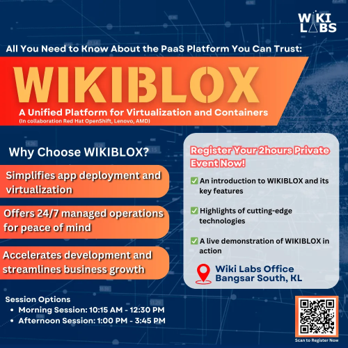
WikiBlox by Wiki Labs Sdn Bhd is engineered on an enterprise-grade architecture that integrates Red Hat OpenShift with Lenovo infrastructure powered by AMD EPYC processors, all operated within Malaysia. The platform unifies virtual-machine and container workloads under managed operations with built-in governance, security, and compliance aligned to Malaysian enterprise standards.
A recent local deployment within the financial services sector demonstrated significantly faster provisioning and measurable cost efficiencies compared with traditional virtualisation environments. For organisations exploring VMware alternatives, WikiBlox distinguishes itself through local support, regulatory alignment, and optimisation for hybrid-cloud and container workloads.
How Wiki Labs Helps Manage Virtualisation Costs
Wiki Labs provides full-lifecycle services for enterprise virtualisation — from assessing existing VMware environments to designing migration frameworks and optimising operations post-deployment.
Through cost-transparency analysis, predictable licensing models, and Malaysia-based support, Wiki Labs helps organisations identify and reduce hidden expenses associated with legacy systems. Its consultants offer clear insights into the total cost of ownership (TCO) across leading VMware alternatives, ensuring each client selects the most cost-effective and scalable approach for long-term growth.
With deep local expertise and platform-agnostic hardware integration, Wiki Labs enables Malaysian enterprises to achieve operational clarity and sustainable cost efficiency in their modernisation journey.
Ready to Move Forward with Modern VMware Alternatives?
WikiBlox isn’t just another platform. It’s your all-in-one foundation for Malaysia’s enterprise IT future.
👉 Schedule a free consultation with Wiki Labs experts today to see how WikiBlox can power your transformation.
Disclaimer:
The information in this article is provided for general informational purposes only. All product names, trademarks, and registered trademarks are the property of their respective owners. References to third-party technologies such as VMware, Red Hat, Lenovo, AMD, and others are made solely to describe compatibility or comparison context and do not imply any endorsement or affiliation.
Wiki Labs Sdn Bhd makes reasonable efforts to ensure the accuracy of information at the time of publication; however, readers are encouraged to verify technical details and licensing information directly with the respective vendors.
