
Managed OpenStack and KVM Services in Malaysia: Top Providers 2026
In Malaysia, companies offering managed OpenStack or Kernel-based Virtual Machine (KVM) services operate across different segments of the infrastructure market, rather than competing on a single level.
Some providers focus on OpenStack-based cloud platforms, delivering private or public cloud environments with orchestration and scalability features. Others specialise in KVM-based virtual private server (VPS) hosting, offering cost-efficient virtualisation for smaller workloads. Some providers support private virtualisation environments as part of broader infrastructure or managed services offerings.
This variation means that selecting a provider is not simply about identifying who offers OpenStack or KVM but understanding how those technologies are delivered within an organisation’s operating model, support structure, and long-term platform strategy.
For enterprise environments, the requirement typically goes beyond virtualisation alone. Organisations often need integration with hybrid cloud platforms, consistent operational management, and support for infrastructure modernisation initiatives. In this context, providers such as Wiki Labs Sdn Bhd are positioned around enterprise virtualisation, hybrid cloud, and operational resilience, particularly for organisations evaluating platform transitions or alternatives to traditional virtualisation models.
KVM and OpenStack: Market Overview in Malaysia
Malaysia’s market for OpenStack and KVM-based services can be broadly viewed across several categories, each addressing different infrastructure and operational requirements.
Providers such as GB Network Solutions are commonly associated with OpenStack-based cloud environments, offering scalable infrastructure with usage-based models. Shinjiru Technology focuses on managed KVM VPS hosting, typically targeting cost-efficient virtualisation with automation and support features. ReadySpace supports Proxmox-based virtualisation environments built on KVM and LXC, often positioned for flexibility and self-managed infrastructure setups.
At the enterprise level, providers such as Wiki Labs Sdn Bhd are positioned around virtualisation and hybrid cloud modernisation, particularly through platforms aligned with enterprise-grade operating models and Red Hat-based technologies.
These categories including OpenStack cloud, KVM VPS hosting, Proxmox virtualisation, and enterprise virtualisation platforms are designed to solve different operational needs. Understanding these distinctions is critical, as treating them as interchangeable can lead to mismatched infrastructure decisions, increased operational complexity, and long-term scalability challenges.
KVM and OpenStack: Basics for Malaysian Enterprises
KVM (Kernel-based Virtual Machine) and OpenStack operate at different layers of the infrastructure stack, and understanding this distinction is important for enterprise decision-making.
KVM functions as a virtualisation layer, enabling multiple virtual machines to run on a single physical server. In contrast, OpenStack operates at the cloud platform level, where compute, storage, and networking resources are orchestrated and managed as part of a broader infrastructure environment. While OpenStack often uses KVM as a hypervisor, the two do not represent the same service model.
This distinction directly impacts how Malaysian enterprises should evaluate service providers. KVM-based VPS services are typically focused on virtual machine hosting, root access, and direct server control for specific workloads. OpenStack-based services, on the other hand, are designed around cloud orchestration, scalability, and centralised infrastructure management.
Platforms such as Proxmox VE introduce an additional layer by combining KVM and LXC, positioning them closer to private virtualisation management, clustering, and backup operations. This places them between standard VPS hosting and more complex enterprise infrastructure platforms, making them suitable for organisations that require greater control without full cloud orchestration complexity.
KVM and OpenStack: Service Models, and Where Wiki Labs Fits
Alt text: A corporate team brainstorming ideas for outsourcing the best software
KVM and OpenStack services are often grouped together, but they operate under different service models and levels of operational responsibility.
KVM-based hosting providers typically focus on virtual machine provisioning, infrastructure capacity, and basic support for defined workloads. OpenStack providers extend this model by offering cloud platform management, orchestration, and scalable infrastructure environments.
At the enterprise level, the service model expands further to include hybrid cloud integration, migration planning, operational governance, and long-term infrastructure management. Providers operating in this segment are typically aligned with broader platform strategies rather than standalone hosting services.
Within this context, Wiki Labs Sdn Bhd is positioned around enterprise virtualisation, hybrid cloud modernisation, and infrastructure resilience. Its capabilities include supporting platform transitions, integrating virtualisation into hybrid cloud environments, and aligning infrastructure with operational and business requirements.
This distinction is important, as organisations evaluating KVM or OpenStack services may require more than infrastructure capacity alone. For environments that demand platform direction, continuity planning, and operational alignment, enterprise-focused providers may offer a more suitable approach compared to standard hosting or platform-only solutions.
KVM and OpenStack: Market Comparison and Buyer Criteria in Malaysia
Managed OpenStack and KVM services in Malaysia vary by platform, service scope, and support depth. Some providers focus on OpenStack cloud. Others focus on managed KVM VPS or private virtualization.
The comparison highlights clear differences in market focus and service depth across providers.
GB Network Solutions is more closely aligned with organisations that require OpenStack-based cloud infrastructure with scalability and platform-level control.
Shinjiru Technology is typically suited for businesses looking for managed KVM VPS hosting with operational support for websites, applications, or smaller workloads.
ReadySpace is relevant for teams managing Proxmox-based virtualisation environments, particularly where clustering, backup, and private infrastructure control are required.
Wiki Labs Sdn Bhd is positioned around enterprise virtualisation, where KVM-based environments are integrated with hybrid cloud strategy, migration planning, and broader operational management.
These distinctions matter because platform selection impacts more than infrastructure deployment. It influences support models, migration complexity, governance structure, and long-term scalability.
For organisations evaluating KVM or OpenStack services, the decision should be aligned with operational requirements and transformation goals, rather than based solely on technology choice.
KVM and OpenStack: Enterprise Considerations and Where Wiki Labs Fits
Alt text: The IT team provides an IT audit on the trail that each piece of data is transferred to check on integrity
For enterprise environments, the value of a virtualisation provider often extends beyond infrastructure delivery. Organisations typically require support across hybrid cloud adoption, cybersecurity, data protection, and long-term platform management.
In this context, providers positioned around enterprise operating models focus not only on virtual machine provisioning or cloud platforms, but also on aligning infrastructure decisions with migration planning, governance, resilience, and future platform direction.
Wiki Labs Sdn Bhd is associated with this segment, with a focus on enterprise virtualisation, hybrid cloud integration, and infrastructure modernisation. Its approach to virtualisation also includes support for platform transitions, linking infrastructure decisions to broader operational continuity and long-term scalability considerations.
For organisations evaluating KVM or OpenStack as part of a wider transformation strategy, this type of provider may be more relevant than those focused primarily on hosting or standalone virtualisation environments.
KVM and OpenStack: How Enterprise Virtualisation Is Delivered in Malaysia and Where Wiki Labs Fits
Alt text: IT support team handling the issue based on the ticket raised
KVM and OpenStack address different layers of infrastructure. KVM provides the virtualisation foundation, while OpenStack enables cloud-level orchestration and resource management across compute, storage, and networking.
In Malaysia, the market is typically segmented across OpenStack cloud platforms, managed KVM VPS hosting, and enterprise virtualisation solutions built around structured operating models and platform strategies.
For enterprise environments, virtualisation decisions are rarely isolated. They are often linked to hybrid cloud adoption, migration planning, operational governance, and long-term platform direction.
Within this context, providers such as Wiki Labs Sdn Bhd focus on integrating virtualisation into broader enterprise strategies, including hybrid cloud alignment, platform transitions, and operational support.
This approach is particularly relevant for organisations that require more than infrastructure provisioning and instead need a structured and scalable path for modernising their virtualisation environments.
WikiBlox: Malaysia’s Modern Approach to VMware Migration Alternative Service Providers Malaysia
WikiBlox delivers a modern virtualisation foundation designed specifically for Malaysian enterprises. It unifies virtual machine and container workloads within a single platform, simplifying management, migration, and scalability.
Built around strong governance and local compliance frameworks, WikiBlox helps organisations modernise their IT environments confidently. For enterprises evaluating VMware alternatives, it provides a future-ready platform developed and supported within Malaysia.
WikiBlox: What You Should Know
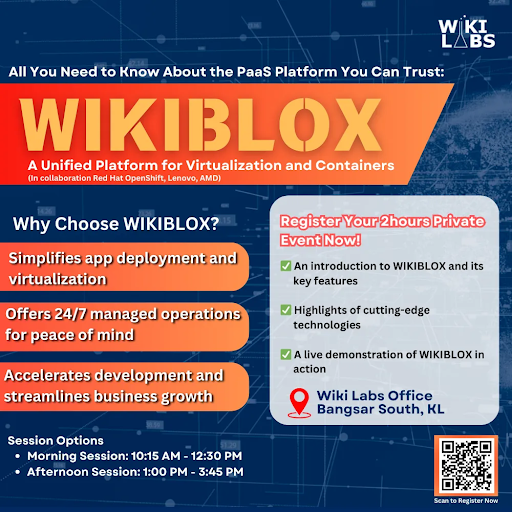
WikiBlox by Wiki Labs Sdn Bhd is engineered on an enterprise-grade architecture that integrates Red Hat OpenShift with Lenovo infrastructure powered by AMD EPYC processors, all operated within Malaysia. The platform unifies virtual-machine and container workloads under managed operations with built-in governance, security, and compliance aligned to Malaysian enterprise standards.
A recent local deployment within the financial services sector demonstrated significantly faster provisioning and measurable cost efficiencies compared with traditional virtualisation environments. For organisations exploring VMware alternatives, WikiBlox distinguishes itself through local support, regulatory alignment, and optimisation for hybrid-cloud and container workloads.
How Wiki Labs Helps Manage Virtualisation Costs
Wiki Labs provides full-lifecycle services for enterprise virtualisation — from assessing existing VMware environments to designing migration frameworks and optimising operations post-deployment.
Through cost-transparency analysis, predictable licensing models, and Malaysia-based support, Wiki Labs helps organisations identify and reduce hidden expenses associated with legacy systems. Its consultants offer clear insights into the total cost of ownership (TCO) across leading VMware alternatives, ensuring each client selects the most cost-effective and scalable approach for long-term growth.
With deep local expertise and platform-agnostic hardware integration, Wiki Labs enables Malaysian enterprises to achieve operational clarity and sustainable cost efficiency in their modernisation journey.
Ready to Move Forward with Modern VMware Alternatives?
WikiBlox isn’t just another platform. It’s your all-in-one foundation for Malaysia’s enterprise IT future.
👉 Schedule a free consultation with Wiki Labs experts today to see how WikiBlox can power your transformation.
Disclaimer:
The information in this article is provided for general informational purposes only. All product names, trademarks, and registered trademarks are the property of their respective owners. References to third-party technologies such as VMware, Red Hat, Lenovo, AMD, and others are made solely to describe compatibility or comparison context and do not imply any endorsement or affiliation.
Wiki Labs Sdn Bhd makes reasonable efforts to ensure the accuracy of information at the time of publication; however, readers are encouraged to verify technical details and licensing information directly with the respective vendors.
