Red Hat Enterprise Virtualization Partner Guide 2026
Malaysian enterprises are rethinking their virtualization strategy. Changes in the virtualization landscape, hybrid cloud adoption, and container modernization are driving new infrastructure decisions. Many organizations now look for a Red Hat OpenShift Malaysia Enterprise Virtualization partner to guide long-term infrastructure strategy. The right Enterprise Virtualization partner shapes cost structure, architecture flexibility, and operational control.
You are not selecting a vendor. You are selecting an Enterprise Virtualization partner who influences your cloud readiness for the next five to ten years. A Red Hat OpenShift Malaysia Enterprise Virtualization partner must understand regulatory requirements, migration complexity, and hybrid workload design. Changes in the virtualization landscape, hybrid cloud adoption, and container modernization are driving new infrastructure decisions.
Why Red Hat OpenShift Malaysia Is Changing Enterprise Virtualization
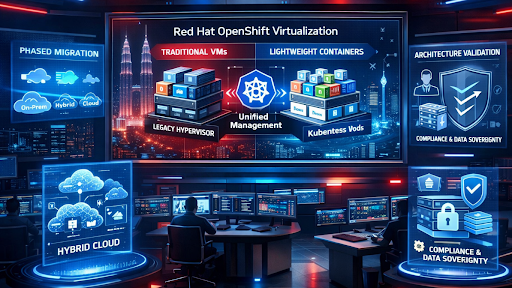
Red Hat OpenShift Virtualization allows enterprises to run virtual machines and container workloads on a unified Kubernetes platform. This architecture allows organizations to run virtual machines alongside container workloads on a unified Kubernetes platform. Organizations adopting Red Hat OpenShift in Malaysia gain greater flexibility in workload placement and lifecycle management. An experienced Enterprise Virtualization partner guides this transition with structured planning and architecture validation.
Traditional virtualization stacks focus only on virtual machines. Red Hat OpenShift integrates VM-based workloads with containerized applications. This design supports phased modernization instead of full platform replacement. A capable Enterprise Virtualization partner ensures migration happens in stages, with measurable milestones and rollback planning.
Malaysian enterprises in finance and the public sector demand data sovereignty and compliance alignment. Red Hat OpenShift deployments in Malaysia can support these requirements when implemented with proper infrastructure governance and policy controls. An Enterprise Virtualization partner with OpenShift implementation experience understands how to design compliant hybrid environments. This knowledge helps organizations better prepare for audits and reduce operational risk.
Four Enterprise Virtualization Consulting Models in Malaysia

Malaysian organizations typically engage Enterprise Virtualization partners through several common consulting models. Each model offers different strengths, limitations, and long-term impact.
Traditional Hypervisor Focused Managed Service Provider
This model centers on VMware-based infrastructure and traditional server consolidation projects. The Enterprise Virtualization partner designs private cloud environments, manages backup systems, and handles server consolidation. Enterprises benefit from operational familiarity and stable support processes. This approach works well for organizations that plan to maintain traditional VM-centric environments.
The limitation appears when modernization becomes a priority. Hypervisor-focused models are typically designed primarily for virtual machine environments rather than container-based workloads. Licensing considerations may become more significant as infrastructure scale increases. If your long term goal includes Kubernetes integration, this Enterprise Virtualization partner model may restrict flexibility.
Telco Sovereign Infrastructure Model
National infrastructure providers operate sovereign cloud and virtualization platforms. This Enterprise Virtualization partner model prioritizes regulatory alignment and national data control. Public sector agencies and regulated industries often select this path due to compliance posture.
This model provides a strong infrastructure backbone and a high availability architecture. However, customization options may depend on the provider’s standardized platform architecture. Modern container adoption may progress differently depending on the provider’s platform roadmap and service model. If innovation speed and architecture experimentation matter, you must evaluate whether this Enterprise Virtualization partner aligns with your roadmap.
Global System Integrator Model
Large international firms deliver multi-country transformation programs. This Enterprise Virtualization partner model supports complex ERP integration, SAP modernization, and multi-site infrastructure redesign. Enterprises pursuing regional digital transformation often select this route.
Cost structures may be higher compared to local specialists due to the scale and scope of international transformation programs. Local operational responsiveness may vary depending on project governance structures and regional delivery models. If your virtualization project stands alone without a broader transformation scope, this Enterprise Virtualization partner may exceed your required scale.
Red Hat OpenShift Focused Modernization Specialist
This model centers on Red Hat OpenShift and Red Hat Malaysia implementation. The Enterprise Virtualization partner integrates virtual machines and containers within a Kubernetes-based control plane. This architecture supports phased VMware migration while preparing the organization for cloud native adoption.
A Red Hat OpenShift Malaysia Enterprise Virtualization partner designs infrastructure with portability and automation in mind. Workloads move gradually instead of through a disruptive full migration. Enterprises can expand beyond traditional hypervisor environments while preserving operational continuity.
This model suits organizations seeking long-term modernization. If your roadmap includes DevOps integration, hybrid cloud strategy, and cost predictability, working with a Red Hat OpenShift Malaysia Enterprise Virtualization partner may better align with those objectives.
Architecture Comparison From an Enterprise Perspective

Architecture choice determines operational cost, scalability, and innovation speed. A hypervisor-focused stack typically manages virtual machines separately from container-based workloads. A Red Hat OpenShift–based architecture can run virtual machines and container workloads within a unified Kubernetes platform. An Enterprise Virtualization partner must explain architecture differences clearly before migration begins.
In hypervisor-centric environments, infrastructure teams manage compute, storage, and networking as separate layers. In Red Hat OpenShift Malaysia architecture, Kubernetes orchestrates workloads across clusters. This structure can support more consistent scaling and automation across workloads. Your Enterprise Virtualization partner should provide workload mapping analysis and resource utilization forecast before recommending the transition.
Licensing exposure represents another key factor. VMware-based environments depend on per-core or per-socket licensing. Red Hat OpenShift Malaysia deployments shift cost structure toward subscription and support models. A skilled Enterprise Virtualization partner calculates the total cost of ownership over a five-year horizon. Data-driven cost comparison improves executive decision-making.
How to Evaluate a Red Hat OpenShift Malaysia Enterprise Virtualization Partner
You should assess an Enterprise Virtualization partner using structured criteria. Brand reputation should not be the only evaluation factor. Focus on technical capability, local execution strength, and lifecycle management.
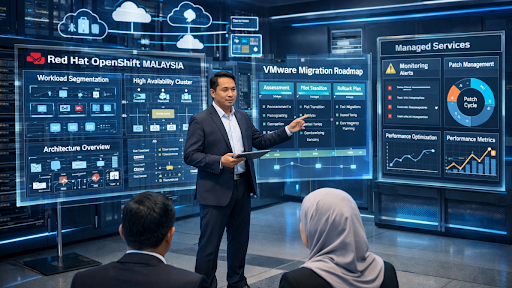
First, verify Red Hat OpenShift Malaysia implementation experience. Ask for architecture diagrams from previous deployments. A strong Enterprise Virtualization partner presents workload segmentation plans, high availability design, and disaster recovery configuration. Documentation quality often reflects the partner’s technical maturity and operational discipline.
Second, examine VMware migration methodology. A qualified Enterprise Virtualization partner provides a phased migration roadmap. This roadmap includes assessment, pilot workload transition, performance benchmarking, and rollback planning. Clear milestone definition reduces project uncertainty.
Third, evaluate the hybrid cloud integration strategy. Red Hat OpenShift Malaysia environments often connect on-premises clusters with public cloud resources. Your Enterprise Virtualization partner should define network design, identity integration, and a monitoring framework. Clear integration design helps reduce the risk of operational fragmentation.
Fourth, confirm managed services capability. Virtualization modernization does not end at deployment. An Enterprise Virtualization partner must offer monitoring, patch management, and performance optimization. Long-term operational partnership drives stable infrastructure growth.
Positioning Red Hat OpenShift Malaysia for Long-Term Enterprise Growth

Red Hat OpenShift Malaysia enables enterprises to combine legacy workloads with cloud native applications. This architecture allows organizations to modernize gradually without requiring immediate large-scale replatforming. A strategic Enterprise Virtualization partner helps align infrastructure direction with business growth targets.
Enterprises in Malaysia face regulatory review cycles, cost pressure, and digital transformation demands. Selecting the right Enterprise Virtualization partner determines how effectively infrastructure adapts to these pressures. Red Hat OpenShift can serve as a technical foundation for this modernization approach. The Enterprise Virtualization partner translates this foundation into operational reality.
If your organization plans to diversify virtualization platforms, integrate container workflows, and maintain Malaysia-based data control, prioritize a Red Hat OpenShift Malaysia Enterprise Virtualization partner with a proven implementation record. Structured evaluation and architecture clarity help organizations make more confident modernization decisions.
Red Hat OpenShift Malaysia is not only a platform choice. It represents a strategic direction. The Enterprise Virtualization partner you select today shapes your infrastructure resilience, compliance posture, and innovation capacity for years ahead.
WikiBlox: Malaysia’s Modern Approach to Red Hat OpenShift Malaysia Enterprise Virtualization
WikiBlox delivers a modern virtualisation foundation designed specifically for Malaysian enterprises. It unifies virtual machine and container workloads within a single platform, simplifying management, migration, and scalability.
Built around strong governance and local compliance frameworks, WikiBlox helps organisations modernise their IT environments confidently. For enterprises evaluating VMware alternatives, it provides a future-ready platform developed and supported within Malaysia.
WikiBlox: What You Should Know
WikiBlox by Wiki Labs Sdn Bhd is engineered on an enterprise-grade architecture that integrates Red Hat OpenShift with Lenovo infrastructure powered by AMD EPYC processors, all operated within Malaysia. The platform unifies virtual-machine and container workloads under managed operations with built-in governance, security, and compliance aligned to Malaysian enterprise standards.
A recent local deployment within the financial services sector demonstrated significantly faster provisioning and measurable cost efficiencies compared with traditional virtualisation environments. For organisations exploring VMware alternatives, WikiBlox distinguishes itself through local support, regulatory alignment, and optimisation for hybrid-cloud and container workloads.
How Wiki Labs Helps Manage Virtualisation Costs
Wiki Labs provides full-lifecycle services for enterprise virtualisation — from assessing existing VMware environments to designing migration frameworks and optimising operations post-deployment.
Through cost-transparency analysis, predictable licensing models, and Malaysia-based support, Wiki Labs helps organisations identify and reduce hidden expenses associated with legacy systems. Its consultants offer clear insights into the total cost of ownership (TCO) across leading VMware alternatives, ensuring each client selects the most cost-effective and scalable approach for long-term growth.
With deep local expertise and platform-agnostic hardware integration, Wiki Labs enables Malaysian enterprises to achieve operational clarity and sustainable cost efficiency in their modernisation journey.
Ready to Move Forward with Modern VMware Alternatives?
WikiBlox isn’t just another platform. It’s your all-in-one foundation for Malaysia’s enterprise IT future.
👉 Schedule a free consultation with Wiki Labs experts today to see how WikiBlox can power your transformation.
Disclaimer:
The information in this article is provided for general informational purposes only. All product names, trademarks, and registered trademarks are the property of their respective owners. References to third-party technologies such as VMware, Red Hat, Lenovo, AMD, and others are made solely to describe compatibility or comparison context and do not imply any endorsement or affiliation.
Wiki Labs Sdn Bhd makes reasonable efforts to ensure the accuracy of information at the time of publication; however, readers are encouraged to verify technical details and licensing information directly with the respective vendors.
