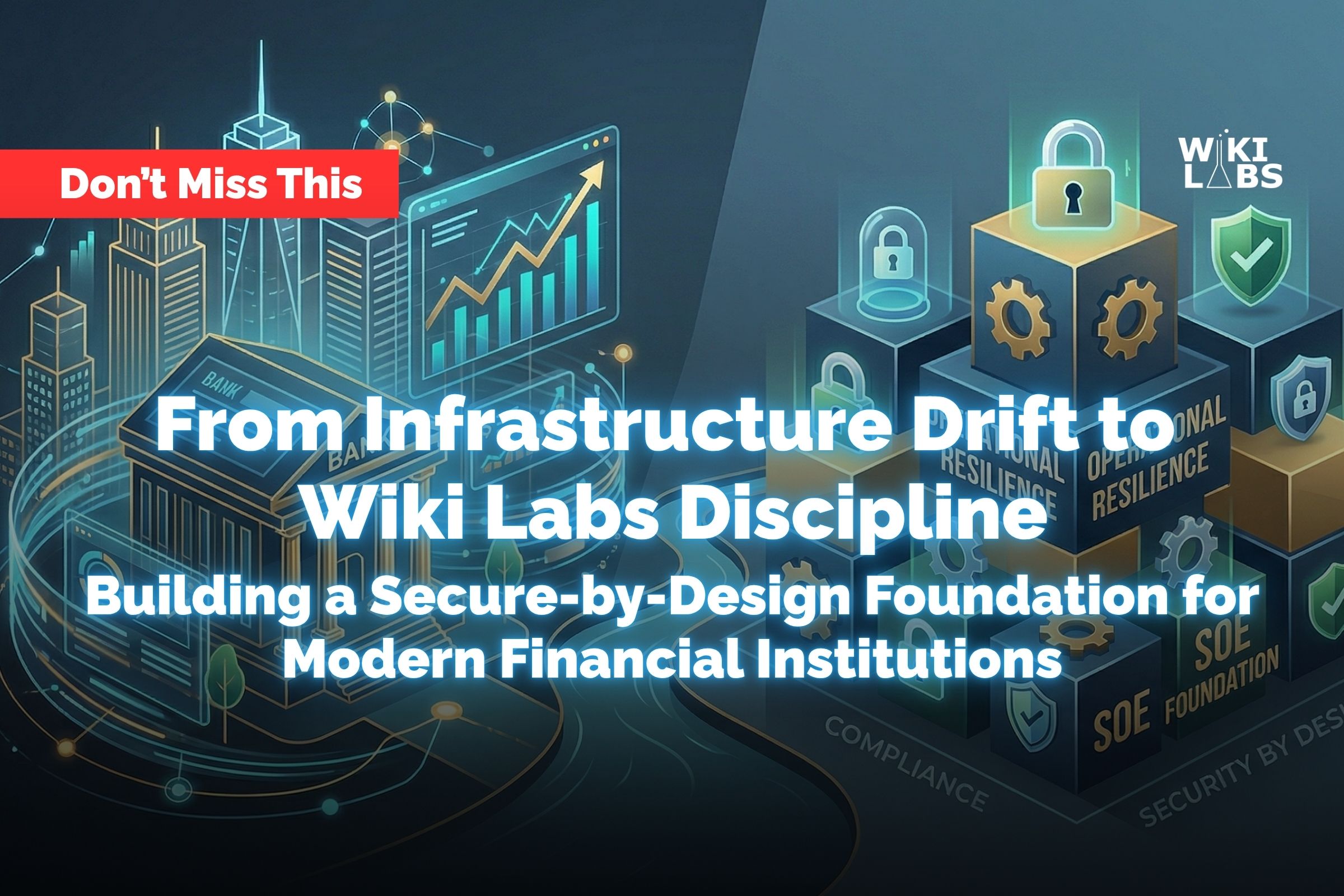
From Infrastructure Drift to Wiki Labs Discipline
Operational Resilience in Financial Services: Strengthening Compliance and Security Through Wiki Labs SOE
The High Stakes of Financial IT Operations
In the Financial Services Industry (FSI), IT infrastructure is more than an operational backbone — it is a foundation of trust. For banks, insurers, and fintech organisations, system failures are not measured solely by downtime. They carry regulatory consequences, reputational impact, and long-term erosion of customer confidence.
As regulatory expectations around technology risk management, cyber resilience, and governance continue to rise, financial institutions face a familiar tension: how to modernise and innovate while maintaining a controlled, compliant, and secure-by-design environment.
For many organisations, the challenge is not a lack of technology, but a lack of operational standardisation.
The Hidden Risk of Infrastructure Drift
Over time, financial institutions often experience gradual configuration drift across their environments. Manual changes, inconsistent patching practices, and differing operational approaches between teams introduce complexity and risk.
This drift commonly results in:
Audit Exposure – Inconsistent system configurations make it difficult to produce reliable evidence during internal and external audits.
Security Gaps – Delayed or uneven patching increases exposure to vulnerabilities, including zero-day threats.
Limited Asset Visibility – Without accurate inventory and logging, organisations struggle to identify and govern all systems under their responsibility, increasing the risk of shadow IT.
In highly regulated environments, these issues compound over time and often surface only when audits, incidents, or regulatory reviews occur.
A Standard Operating Environment Built for Regulation
A Standard Operating Environment (SOE) provides a structured, repeatable operating model that enables financial institutions to regain control without sacrificing agility. Rather than focusing on individual tools, SOE establishes consistency across how systems are built, secured, maintained, and monitored throughout their lifecycle.
Within regulated environments, an SOE approach typically emphasises the following areas:
1. Security Hardening and Configuration Governance
From initial provisioning, systems are deployed according to defined security baselines and configuration standards. Continuous compliance checks help ensure environments remain aligned with internal policies and regulatory expectations as they evolve.
2. Lifecycle and Patch Management
Effective software lifecycle management supports both planned maintenance cycles and rapid response to critical vulnerabilities. This reduces reliance on manual intervention while helping institutions maintain a consistent compliance posture.
3. End-to-End Asset Visibility
Accurate inventory and log management enable clear oversight of infrastructure assets and application criticality. This visibility is essential for audit readiness, risk assessment, and informed decision-making.
4. Operational Resilience and Incident Response
Standardised fault and incident management processes support timely resolution of issues based on defined service levels. For core financial systems, this operational discipline is central to maintaining availability and regulatory confidence.
Why Institutions Work with Partners Like Wiki Labs
In highly regulated financial environments, successful SOE adoption is rarely driven by technology alone. It is shaped by repeated audit cycles, regulatory reviews, availability requirements, and the operational pressure that comes with running mission-critical systems at scale.
Institutions operating under these conditions typically work with partners who understand that operational resilience is built over time — through disciplined processes, governance, and accountability — rather than one-off implementations.
In practice, SOE frameworks are often adopted after organisations encounter recurring audit findings, operational incidents, or growing difficulty maintaining consistency across teams and platforms. A structured SOE approach helps shift operations from reactive remediation to proactive governance.
This is the operating context in which partners like Wiki Labs support financial institutions: environments where traceability, standardisation, and outcome ownership are essential, and where operational models must withstand ongoing regulatory scrutiny while still enabling future scalability.
Building a More Predictable Operational Future
As financial institutions continue to evolve their digital platforms, operational resilience depends less on individual technologies and more on the discipline of how environments are managed day to day.
A well-defined SOE helps organisations reduce uncertainty, improve audit readiness, and create a stable foundation for future transformation — without compromising security or governance.
For institutions reviewing their current operational and compliance posture, an SOE assessment is often the first step in identifying configuration gaps, operational risks, and opportunities for improvement before they surface during audits or incidents.
