Explore Red Hat OpenShift Virtualization as a VMware Alternative
An Overview: Red Hat OpenShift Virtualisation
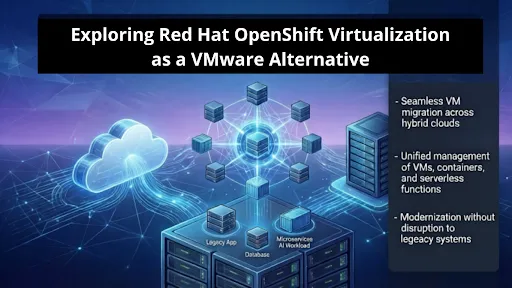
Red Hat OpenShift Virtualization is a capability within Red Hat OpenShift that allows enterprises to run and manage both traditional virtual machines (VMs) and containerised workloads on a single platform. It helps organisations migrate and modernise existing VM workloads while integrating new technologies such as AI within a hybrid cloud environment.
Key capabilities of Red Hat OpenShift Virtualization include:
Seamlessly migrating and running VMs across hybrid cloud setups.
Managing VMs alongside containers and serverless workloads.
Modernising your infrastructure without disrupting existing systems.
The infrastructure landscape is evolving. Enterprises in Malaysia and beyond are managing both legacy virtual machine (VMs) workloads and modern container‑based applications. The platform-like Red Hat OpenShift (OpenShift) offers functionality that spans both areas. This article explores how OpenShift Virtualization can complement existing virtualisation environments and what Malaysian enterprises should consider when assessing VMware alternatives.
Red Hat OpenShift Virtualization and the Shift Towards Hybrid Cloud in Malaysia

Over recent years, the nature of IT infrastructure has shifted. Traditional VM‑centric platforms continue to serve many enterprise workloads. At the same time, container‑native platforms (such as OpenShift) have gained traction for modern application deployment. In response, platforms like OpenShift Virtualisation allow VMs and containers to run side‑by‑side on a unified platform. For example, OpenShift Virtualization supports running and migrating existing virtual machine workloads at scale while enabling VMs to be managed alongside containers and serverless workloads” via Red Hat.
For Malaysian enterprises, this shift means that infrastructure decisions are no longer about simply replacing one platform with another. It is about aligning workloads, investment, and operational models to a platform that supports hybrid and multicloud models, container and VM convergence, and longer‑term flexibility.
Strategic Advice for Malaysian Businesses

Malaysian enterprises should approach this evolution thoughtfully:
Start with alignment to business goals. Determine how many VMs you have, what container usage you already have or expect, and how your platform strategy supports growth, agility, regulatory needs, and localisation.
Inventory existing workloads. Catalogue VM estates, containerised applications, data gravity, latency and performance requirements, and hybrid cloud dependencies..
Evaluate platforms for flexibility and future use, particularly those that support unified management of virtual machines and containers, such as Red Hat OpenShift Virtualization..
Adopt a phased approach. Rather than switching everything in one go, consider pilots, less critical workloads, and build operational maturity around new models.
Ensure local‑region support and partner readiness. In Malaysia, ensure your chosen solution (such as OpenShift via a local Red Hat partner) offers local support, regional compliance, and ecosystem integration.
Focus on long‑term infrastructure alignment. Think beyond current virtualisation. The platform you choose should support container‑native workloads, serverless, AI/ML readiness, hybrid‑cloud deployment and diverse hardware.
Plan skills and operational change. Managing a unified platform (VMs + containers) often requires new tooling, DevOps practices, and governance models.
Neutral Comparison of Platforms: Flexibility, Scalability, and Suitability
This section compares a unified platform approach with traditional VM-centric platforms, focusing on architectural characteristics rather than vendors.
In this comparison, the goal is not to favour one over the other but to highlight suitability based on your context. For example, if your workloads are overwhelmingly VM‑based and your operations are mature on that model, a VM‑centric platform remains valid. If you expect a rising container footprint, hybrid deployment, or want unified operations, unified platforms that support both virtual machines and containers may become more relevant.
Long‑Term Planning: Aligning IT Strategy with Future Developments
When planning infrastructure strategy over the next three to five years in Malaysia:
Adopt a “platform first” mindset. Choose infrastructure that supports not only today’s workloads but also tomorrow’s: containers, serverless, edge, and hybrid cloud.
Manage technical debt and divergence. Use a platform strategy that avoids silos (VM only, container only) and supports gradual evolution.
Design for hybrid and multicloud. Malaysia’s data‑sovereignty, latency, and cloud‑vendor choice concerns suggest you need flexibility. Unified platforms that support both virtual machines and containers enable workloads across on-premises, public cloud, and edge environments. (Red Hat)
Build skills and ecosystem now. Even if migration is phased, start building team capability around unified platforms, container orchestration, automation, and operations.
Plan for governance, security, and operations. Unified platforms require adapted policies for containers + VMs, secure configuration, monitoring, and lifecycle management.
Budget for the total cost of ownership (TCO) across years. Focus on operational efficiency, asset reuse, workload consolidation, and avoiding fragmentation.
Monitor ecosystem and roadmap. Platforms evolve; Platform roadmaps should also be monitored, particularly for capabilities such as disaster-recovery orchestration built on Kubernetes-native constructs. (Red Hat Developer)
By aligning infrastructure decisions with your strategic goals and evolving technology needs, Malaysian organisations can position themselves for consistent execution rather than reactive shifts.
Conclusion
In Malaysia’s enterprise landscape, where legacy VM workloads coexist with modern application demands, platforms that support both virtual machines and container-based workloads, such as Red Hat OpenShift Virtualization, present options worth evaluating. The key is to approach decisions strategically: assessing the current state, mapping future needs, evaluating flexibility and scalability, and investing in operations and skills..
This article does not advocate an urgent transition or imply that any existing platform is underperforming. Rather, it emphasises informed assessment and alignment with long‑term goals. By doing so, Malaysian businesses can stay current, prepared, and capable of evolving their infrastructure in step with their future application and workload demands.
WikiBlox: A Modern Virtualisation Platform for Malaysian Enterprises
WikiBlox provides a modern virtualisation foundation designed to support the needs of Malaysian enterprises. It unifies virtual machine and container workloads within a single platform, simplifying management, migration, and scalability.
Built around strong governance and local compliance frameworks, WikiBlox helps organisations modernise their IT environments confidently. For enterprises evaluating alternatives to traditional virtualisation platforms, WikiBlox offers a future-ready option developed and supported within Malaysia.
WikiBlox: What You Should Know

WikiBlox developed by Wiki Labs Sdn Bhd, is built on an enterprise-grade architecture that integrates Red Hat OpenShift with Lenovo infrastructure powered by AMD EPYC processors, and is operated within Malaysia.. The platform unifies virtual-machine and container workloads under managed operations with built-in governance, security, and compliance aligned to Malaysian enterprise standards.
A recent local deployment within the financial services sector demonstrated improvements in provisioning speed and measurable cost efficiencies compared with traditional virtualisation environments. For organisations exploring alternatives to traditional virtualisation platforms, WikiBlox is differentiated by local support, regulatory alignment, and optimisation for hybrid-cloud and container workloads.
How Wiki Labs Helps Manage Virtualisation Costs
Wiki Labs provides full-lifecycle services for enterprise virtualisation — from assessing existing virtualisation environments to designing migration frameworks and optimising operations post-deployment.
Through cost-transparency analysis, predictable licensing models, and Malaysia-based support, Wiki Labs helps organisations identify and reduce hidden expenses associated with legacy systems. Its consultants offer clear insights into the total cost of ownership (TCO) across leading VMware alternatives, supporting informed decisions around cost-effective and scalable approaches aligned with long-term growth.
With deep local expertise and platform-agnostic hardware integration, Wiki Labs enables Malaysian enterprises to achieve operational clarity and sustainable cost efficiency in their modernisation journey.
Ready to Move Forward with Modern VMware Alternatives?
WikiBlox isn’t just another platform. It’s your all-in-one foundation for Malaysia’s enterprise IT future.
👉 Schedule a free consultation with Wiki Labs experts today to see how WikiBlox can power your transformation.
Disclaimer:
The information in this article is provided for general informational purposes only. All product names, trademarks, and registered trademarks are the property of their respective owners. References to third-party technologies such as VMware, Red Hat, Lenovo, AMD, and others are made solely to describe compatibility or comparison context and do not imply any endorsement or affiliation.
Wiki Labs Sdn Bhd makes reasonable efforts to ensure the accuracy of information at the time of publication; however, readers are encouraged to verify technical details and licensing information directly with the respective vendors.
