VMware Exit Case Studies: Global Lessons for Malaysian CIOs
Two out of three major VMware exit case studies from 2025 and 2026 completed with zero downtime. That outcome is repeatable, but only for organisations that start planning before the renewal deadline forces the decision.
Based on Gartner, Broadcom's price increases of 300 to 1,050% have pushed 73% of VMware customers into active evaluation mode. Malaysian CIOs sit in that group with one extra consideration: VMware Cloud Foundation is priced in USD, and ringgit-denominated budgets absorb every exchange rate move before the licence is even renewed.
Why Companies Are Leaving VMware After Broadcom
Broadcom completed its acquisition of VMware in November 2023, introducing a subscription-based licensing model, per-core pricing, and a simplified product portfolio. These commercial changes have prompted many organisations to reassess whether their existing VMware investment still aligns with their operational and financial objectives.
According to Gartner research, as reported by Virtualization Review, 55% of enterprises are expected to initiate proof-of-concept projects for alternative distributed hybrid infrastructure by 2028, compared with just 15% in 2025.This does not suggest that every VMware customer will migrate away from the platform. Instead, it highlights that evaluating VMware alternatives, migration readiness, and long-term infrastructure strategy has become a standard discussion at board and executive levels.
While every organisation has different priorities, three common issues are driving VMware exit decisions across the enterprise market decisions:
Cost and licensing structure. Per-core licensing and bundled product offerings may increase the total cost of ownership, particularly for organisations that only utilise a subset of the VMware portfolio.
Contract and support changes. Evolving licensing terms, support models, and partner programmes can make long-term budgeting and procurement planning more challenging, particularly when renewal timelines are compressed.
Platform dependency. Highly integrated compute, storage, networking, backup, and management capabilities can increase migration complexity, making future platform transitions more time-consuming and resource-intensive.
Understanding Broadcom's VMware licensing and commercial changes is only the first step. The more important question is whether maintaining the current environment, modernising selected workloads, or adopting an alternative platform will deliver the best balance of cost, operational resilience, scalability, and long-term business value.
VMware Exit Case Studies: Three Real Migrations

A meaningful VMware migration case study should clearly explain the migration scope, the business driver behind the decision, the target platform, and the measurable business outcomes. These details allow IT leaders to evaluate whether the lessons are applicable to their own environment. The following case studies illustrate three distinct VMware exit strategies, demonstrating that there is no single migration path for every organisation.
Case Study 1: Kimley-Horn Completed A Full VMware Exit In 60 Days
Kimley-Horn, a US-based engineering consultancy, migrated its cloud-hosted virtual desktop infrastructure (VDI) from VMware Horizon (now part of Omnissa) to Nerdio after evaluating several alternatives against demanding CAD performance requirements. Because both environments were built on Microsoft Azure, desktop images and user profiles were migrated within days, significantly reducing transition complexity.
Scope: Migration of cloud-based VDI workloads rather than a complete VMware infrastructure replacement.
Forcing event: Rising subscription costs and reduced commercial flexibility following licence renewal.
Approach: Conducted proof-of-concept testing using production-like CAD workloads before committing to migration.
Outcome: Achieved measurable cost savings across virtual machines, storage, managed disks, and autoscaling resources while maintaining application performance.
Critical lesson: Successful VMware exits do not have to begin with a complete infrastructure replacement. By identifying a clearly defined workload with measurable business value, organisations can reduce migration risk, validate their strategy, and build confidence before expanding to larger environments.
Case Study 2: Alinsco Insurance Modernised Its Virtualisation Platform Using Existing Hardware
Alinsco Insurance migrated from VMware on Dell VxRail to VergeOS across its headquarters and international locations. The vendor-reported project used a node-by-node method during business hours, with no scheduled maintenance window.
Scope: Full migration from a VMware-based Dell VxRail environment to VergeOS while retaining the existing hardware infrastructure.
Forcing event: Rising licensing costs and uncertainty surrounding future VMware renewals.
Approach: Reused the existing hardware platform and performed a phased, node-by-node migration to minimise operational disruption.
Outcome: According to the vendor, the migration was completed without reported downtime, avoided an immediate hardware refresh, and simplified infrastructure management by reducing the number of separate management tools.
Critical lesson: Existing hardware should be assessed as part of the migration strategy, not treated as an automatic replacement requirement. Reusing compatible infrastructure can significantly reduce capital expenditure, but organisations should independently validate hardware compatibility, migration methodology, backup architecture, and vendor claims before making a final platform decision.
For Malaysian enterprises, this approach can help reduce upfront capital expenditure while allowing infrastructure modernisation to fit within existing budgeting and procurement cycles.
Case Study 3: Tesco Began a Multi-Year VMware Exit Programme
Tesco operates a VMware environment supporting approximately 40,000 server workloads across its retail operations. According to reports published in 2026, the company has begun a phased migration away from VMware while relying on third-party support during the transition. Tesco aims to complete the migration by the end of 2027, although the replacement platform has not been publicly disclosed.
Scope: Approximately 40,000 server workloads
Forcing event: VMware licensing changes and commercial uncertainty following the Broadcom acquisition.
Approach: Multi-year migration with an interim support bridge
Outcome: The migration programme remains in progress, and the replacement platform has not been publicly disclosed.
Critical lesson: Large VMware exits are portfolio programmes, not simply hypervisor replacements. Contract management, security updates, rollback planning, application ownership, and phased migration governance must remain aligned throughout the transition.
What the VMware Exit Case Studies Share
The three cases differ in scale, but the execution pattern is similar. Each organisation had a clear forcing event and matched its transition approach to the scope of the estate. Where the target platform was publicly disclosed, testing used representative production workloads.
The strongest common lessons are:
Separate partial exit, full migration, and application modernisation into different workstreams.
Complete inventory and dependency mapping before committing to a deadline.
Test performance, backup, disaster recovery, networking, and operational tooling, not just VM conversion.
Keep a supported rollback or transition path until each migration wave is accepted.
Rather than treating VMware exit as a one-time migration project, successful organisations approach it as a structured infrastructure transformation programme. This mindset enables IT leaders to balance operational continuity, commercial objectives, and long-term platform flexibility throughout the migration journey.
A Practical Decision Framework for VMware Exit
Most organisations will adopt a combination of these strategies rather than relying on a single approach. The right decision should be based on each application's business value, technical requirements, and operational risk—not solely on the underlying virtualisation platform.
Legacy applications such as ERP systems may be better suited for migration, while newer digital services may benefit more from application modernisation. Applying the same strategy to every workload often increases project complexity, costs, and delivery risk.
For a detailed comparison of today's leading virtualisation platforms, read our guide to VMware alternatives for Malaysian enterprises before creating your proof-of-concept shortlist.
What VMware Exit Case Studies Mean for Malaysian CIOs

FX Exposure Must Be Modelled, Not Assumed
Where VMware pricing or distributor costs are linked to US dollars, a Malaysian enterprise carries MYR/USD exposure across the contract term. Build the stay-versus-migrate business case in Malaysian Ringgit (MYR) and evaluate multiple exchange-rate scenarios to understand the long-term financial impact. The financial assessment should include hardware reuse, implementation services, skills development, backup and disaster recovery changes, ongoing support, and any temporary dual-running costs during the migration period.
Regulatory Requirements Affect the Migration Sequence
For financial institutions, Bank Negara Malaysia's Risk Management in Technology (RMiT) policy requires organisations to consider operational resilience, technology lifecycle management, disaster recovery testing, third-party risk management, and change governance as part of any infrastructure transformation initiative.
No virtualisation platform is inherently compliant. Compliance depends on how the platform is designed, implemented, operated, monitored, and governed throughout its lifecycle.
Partner and Procurement Lead Times Need Early Verification
Organisations should not assume that their existing reseller, cloud provider, or support partner can offer the same VMware commercial terms at the next renewal. Verify current authorisation status, support entitlements, escalation responsibilities, and quotation validity as early as possible. Verify current authorisation, support entitlement, escalation ownership, and quote validity directly.
Procurement processes within Malaysian government agencies, GLCs, and regulated enterprises can extend project timelines by several months. These approval cycles should be incorporated into migration planning from the outset rather than after the technical evaluation has been completed.
Taken together, these considerations reinforce an important point: a successful VMware exit is not driven solely by technology. Commercial planning, regulatory obligations, procurement timelines, and operational governance are equally important in determining the success of the migration programme.
VMware Exit Planning Checklist for Malaysian Enterprises
Before evaluating VMware alternatives, prepare three essential decision artefacts: a workload and dependency assessment, a three-year total cost of ownership (TCO) model in Malaysian Ringgit (MYR), and a risk register covering technical, regulatory, commercial, and operational considerations.
The following checklist provides a practical starting point:
Confirm renewal dates, entitlements, SKUs, support status, and partner authorisation.
Inventory VMs, hosts, storage, networks, backup jobs, licences, and application owners.
Map east-west dependencies and identify workloads with strict RTO, RPO, latency, or compliance requirements.
Review product lifecycle status, software support coverage, and security exposure for every VMware component currently in use.
Obtain a baseline renewal quotation and compare it with at least two alternative platform options using a three-year MYR TCO model.
Test representative workloads through a proof of concept, including backup and recovery.
Assess which hardware assets can be retained and identify any infrastructure components that require replacement or upgrading.
Define migration waves, rollback criteria, business acceptance owners, change windows, and a temporary dual-running budget.
Confirm all applicable RMiT, PDPA, public-sector, and internal governance approvals before production cutover.
For many organisations, a VMware exit is technically achievable. The organisations that succeed are those that transform licensing pressure into a structured migration programme before renewal deadlines limit their options. With the right planning, governance, and execution strategy, VMware exit becomes a controlled business transformation rather than a high-risk infrastructure project.
Wiki Labs Sdn Bhd works with enterprise IT teams to assess migration readiness, evaluate platform options, and build practical VMware exit roadmaps that align with operational, commercial, and regulatory requirements.
WikiBlox: What You Should Know
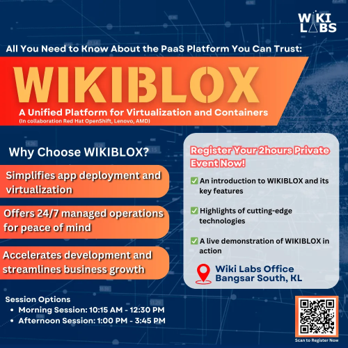
WikiBlox by Wiki Labs Sdn Bhd is engineered on an enterprise-grade architecture that integrates Red Hat OpenShift with Lenovo infrastructure powered by AMD EPYC processors, all operated within Malaysia. The platform unifies virtual-machine and container workloads under managed operations with built-in governance, security, and compliance aligned to Malaysian enterprise standards.
A recent local deployment within the financial services sector demonstrated significantly faster provisioning and measurable cost efficiencies compared with traditional virtualisation environments. For organisations exploring VMware alternatives, WikiBlox distinguishes itself through local support, regulatory alignment, and optimisation for hybrid-cloud and container workloads.
How Wiki Labs Helps Manage Virtualisation Costs
Wiki Labs provides full-lifecycle services for enterprise virtualisation — from assessing existing VMware environments to designing migration frameworks and optimising operations post-deployment.
Through cost-transparency analysis, predictable licensing models, and Malaysia-based support, Wiki Labs helps organisations identify and reduce hidden expenses associated with legacy systems. Its consultants offer clear insights into the total cost of ownership (TCO) across leading VMware alternatives, ensuring each client selects the most cost-effective and scalable approach for long-term growth.
With deep local expertise and platform-agnostic hardware integration, Wiki Labs enables Malaysian enterprises to achieve operational clarity and sustainable cost efficiency in their modernisation journey.
Ready to Move Forward with Modern VMware Alternatives?
WikiBlox isn’t just another platform. It’s your all-in-one foundation for Malaysia’s enterprise IT future.
👉 Schedule a free consultation with Wiki Labs experts today to see how WikiBlox can power your transformation.
Disclaimer:
The information in this article is provided for general informational purposes only. All product names, trademarks, and registered trademarks are the property of their respective owners. References to third-party technologies such as VMware, Red Hat, Lenovo, AMD, and others are made solely to describe compatibility or comparison context and do not imply any endorsement or affiliation.
Wiki Labs Sdn Bhd makes reasonable efforts to ensure the accuracy of information at the time of publication; however, readers are encouraged to verify technical details and licensing information directly with the respective vendors.
