The Real ROI of VMware to KVM Migration for Malaysian Companies
The real VMware to KVM migration ROI for Malaysian companies should not be judged by cheaper platform cost alone. A migration only makes business sense when the 3 year cost gap is larger than the full cost of moving, testing, training, supporting, and protecting workloads after cutover. If the project creates downtime, weak backup recovery, unclear support ownership, or extra workload for the IT team, the expected ROI can shrink quickly.
For many Malaysian companies, the pressure starts when the VMware renewal cost becomes harder to match with the actual size and value of the environment. Some businesses may still need VMware because of existing tools, skills, and operational habits. Others may find that a KVM-based platform gives enough control, flexibility, and cost predictability for their current workloads.
The key question is not “Is KVM cheaper than VMware?” The better question is “Can the company move suitable workloads to KVM without losing uptime, support quality, backup confidence, or operational control?” That is where the VMware to KVM migration ROI becomes useful. It helps organisations evaluate renewal pressure, migration costs, platform fit, and long-term infrastructure direction before committing to a new virtualization strategy.
What Is the Real VMware to KVM migration ROI?
VMware to KVM migration ROI measures the financial return from moving a VMware environment to a KVM-based platform after all major costs are included. The basic calculation compares the 3 year VMware platform cost with the 3 year KVM platform cost, then subtracts the migration project cost. A proper ROI view also includes assessment, testing, downtime control, backup redesign, staff training, documentation, and post migration support.
For Malaysian companies, the calculation should not focus on license savings alone. The business needs to check whether the current VMware renewal still matches its workload size, internal skills, support needs, and modernization plan. VMware to KVM migration ROI becomes stronger when the company is paying for VMware capacity, bundles, or features that do not support daily operations.
The most practical way to evaluate VMware to KVM migration ROI is to compare the expected reduction in platform costs against the full cost of migration over a three-year period. This includes not only software and infrastructure expenses, but also assessment, testing, training, operational changes, and post-migration support.
For management teams, the goal is not simply to achieve lower licensing costs. The more important question is how quickly the organisation can recover its migration investment while maintaining operational stability, support quality, and business continuity. A well-planned migration should deliver both financial savings and long-term operational benefits.
The 2026 VMware Cost Pressure Facing Malaysian Companies

In 2026, VMware cost review has become a budget planning issue for Malaysian companies. Virtualization decisions now affect cash flow, renewal timing, infrastructure risk, and long term platform control. The question is no longer whether VMware works, but whether the renewal model still fits the company’s actual environment and budget.
VMware vSphere Foundation and VMware Cloud Foundation use physical core based licensing. Broadcom explains that subscription capacity for VCF and VVF depends on the total physical CPU cores across ESXi hosts, with a minimum of 16 cores for each CPU. This means companies need to count hosts, sockets, and cores before comparing VMware renewal cost with KVM based alternatives.
VMware to KVM migration ROI becomes relevant when a company wants stronger control over recurring platform cost and support direction. KVM-based platforms such as Proxmox VE, OpenShift Virtualization, and other Linux-based virtualization solutions provide organisations with alternative approaches to infrastructure management, licensing, and platform control. The suitability of each option depends on workload requirements, operational capabilities, support expectations, and long-term modernization goals.
2026 Cost Snapshot for VMware to KVM migration ROI in Malaysia
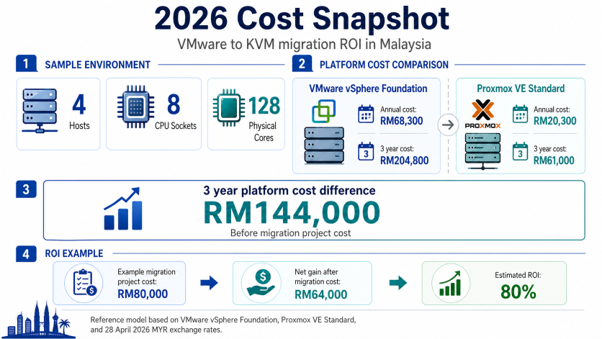
A meaningful VMware to KVM migration ROI assessment should consider more than platform subscription costs alone. Malaysian organisations evaluating a migration should compare their current VMware renewal costs against the total cost of adopting and operating a KVM-based platform over a multi-year period.
The evaluation should include infrastructure licensing or subscription costs, migration planning, workload testing, staff training, operational support, backup and recovery requirements, and any changes to day-to-day management processes. While KVM-based platforms may offer potential cost advantages, the actual business outcome depends on the organisation's environment, workload complexity, operational requirements, and long-term infrastructure strategy.
Rather than focusing solely on immediate cost reductions, organisations should assess how quickly the migration investment can be recovered while maintaining service availability, operational stability, and support quality. A successful migration delivers value not only through lower platform costs, but also through improved flexibility, greater control over infrastructure decisions, and better alignment with future modernization initiatives.
Understanding VMware to KVM Migration ROI for Malaysian Organisations
A positive VMware to KVM migration ROI means the long-term benefits of the migration outweigh the total cost of implementation. These benefits may include lower platform costs, improved cost predictability, greater infrastructure flexibility, and reduced dependency on specific licensing models. For many Malaysian organisations, the discussion is no longer centred on platform preference alone, but on how infrastructure decisions impact operational efficiency, budgeting, and long-term technology planning.
The value of a migration depends heavily on project execution. Organisations should evaluate whether the migration plan includes workload assessment, backup validation, testing, rollback procedures, documentation, knowledge transfer, and post-migration support. A well-managed migration helps reduce operational risk and protects the expected business outcomes of the project.
VMware to KVM migration ROI is often most relevant for organisations with stable virtual machine workloads, predictable infrastructure requirements, and a clear need to optimise long-term operating costs. Before proceeding, decision makers should assess whether the current VMware environment continues to provide sufficient value, whether the workloads are suitable for migration, and whether the expected operational and financial benefits justify the investment.
What Must Be Included in the VMware to KVM Migration Scope?
A strong VMware to KVM migration ROI needs a complete scope, not only VM conversion. The project should protect uptime, recovery, internal readiness, and support after cutover.
Environment assessment: Review hosts, clusters, storage, networking, VM count, resource usage, licensing, and backup tools. This shows what should migrate, what should be removed, and what needs redesign.
VM inventory and application mapping: Match each virtual machine with the business application it supports. This helps identify critical workloads, low risk workloads, legacy systems, and applications that need extra testing.
Pilot migration and validation: Start with low risk workloads before moving critical systems. Disk conversion needs driver checks, network mapping, storage validation, monitoring updates, and restore testing.
Backup, rollback, and downtime planning: Test backups, define rollback steps, and agree on downtime windows before production migration. This reduces the risk of failed cutovers.
Documentation, handover, and support ownership: Confirm who handles incidents, escalation, response time, and internal knowledge transfer. VMware to KVM migration ROI improves when cost savings do not create support confusion.
Risks That Reduce VMware to KVM migration ROI

VMware to KVM migration ROI can drop quickly when the project focuses only on platform cost. Downtime, failed testing, unsupported legacy workloads, weak backup design, missing rollback plans, and internal skills gaps all create extra cost. These risks can affect business operations more than the licensing difference, especially when critical applications move without proper validation.
Compatibility should be reviewed before any production migration. Some workloads may depend on VMware specific tools, backup integrations, monitoring agents, network settings, or operating system drivers. A safer approach is to rank workloads by business criticality, begin with low risk systems, complete a pilot migration, then move critical applications only after performance, backup, and restore testing are proven.
Beyond technical validation, organisations should also consider compliance and data governance requirements as part of the migration planning process. Any business handling personal data needs to review administrator access, backup location, retention policy, managed service responsibility, and recovery procedures. The business case for VMware to KVM migration becomes more compelling when organisations can reduce platform costs while maintaining control over uptime, data protection, and operational accountability.
Conclusion: VMware to KVM Migration ROI Depends on Cost, Risk, and Long-Term Fit
The real VMware to KVM migration ROI is determined by more than platform pricing alone. Organisations need to evaluate the gap between VMware renewal costs and the total cost of migration, while also considering workload suitability, operational requirements, support expectations, and long-term infrastructure objectives. In some environments, VMware may continue to provide the right balance of functionality and operational familiarity. In others, a KVM-based platform may offer a more sustainable path for cost optimisation and infrastructure modernisation.
A successful migration is not defined solely by lower licensing costs. The strongest business outcomes are achieved when organisations can reduce ongoing platform expenses without compromising service availability, data protection, operational control, or support quality. This requires careful planning, realistic cost assessment, and a migration strategy aligned with business priorities.
Before making a decision, organisations should perform a structured assessment of their workloads, infrastructure dependencies, recovery requirements, support model, and future growth plans. A well-executed migration creates value when financial savings are supported by operational stability, business continuity, and long-term platform flexibility.
WikiBlox: Malaysia’s Modern Approach to VMware Migration Alternative Service Providers Malaysia
WikiBlox delivers a modern virtualisation foundation designed specifically for Malaysian enterprises. It unifies virtual machine and container workloads within a single platform, simplifying management, migration, and scalability.
Built around strong governance and local compliance frameworks, WikiBlox helps organisations modernise their IT environments confidently. For enterprises evaluating VMware alternatives, it provides a future-ready platform developed and supported within Malaysia.
WikiBlox: What You Should Know
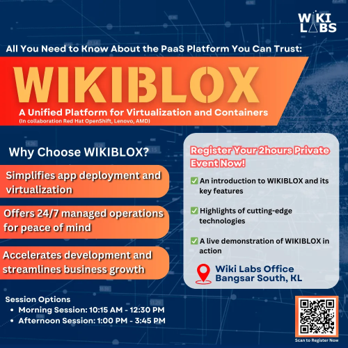
WikiBlox by Wiki Labs Sdn Bhd is engineered on an enterprise-grade architecture that integrates Red Hat OpenShift with Lenovo infrastructure powered by AMD EPYC processors, all operated within Malaysia. The platform unifies virtual-machine and container workloads under managed operations with built-in governance, security, and compliance aligned to Malaysian enterprise standards.
A recent local deployment within the financial services sector demonstrated significantly faster provisioning and measurable cost efficiencies compared with traditional virtualisation environments. For organisations exploring VMware alternatives, WikiBlox distinguishes itself through local support, regulatory alignment, and optimisation for hybrid-cloud and container workloads.
How Wiki Labs Helps Manage Virtualisation Costs
Wiki Labs provides full-lifecycle services for enterprise virtualisation — from assessing existing VMware environments to designing migration frameworks and optimising operations post-deployment.
Through cost-transparency analysis, predictable licensing models, and Malaysia-based support, Wiki Labs helps organisations identify and reduce hidden expenses associated with legacy systems. Its consultants offer clear insights into the total cost of ownership (TCO) across leading VMware alternatives, ensuring each client selects the most cost-effective and scalable approach for long-term growth.
With deep local expertise and platform-agnostic hardware integration, Wiki Labs enables Malaysian enterprises to achieve operational clarity and sustainable cost efficiency in their modernisation journey.
Ready to Move Forward with Modern VMware Alternatives?
WikiBlox isn’t just another platform. It’s your all-in-one foundation for Malaysia’s enterprise IT future.
👉 Schedule a free consultation with Wiki Labs experts today to see how WikiBlox can power your transformation.
Disclaimer:
The information in this article is provided for general informational purposes only. All product names, trademarks, and registered trademarks are the property of their respective owners. References to third-party technologies such as VMware, Red Hat, Lenovo, AMD, and others are made solely to describe compatibility or comparison context and do not imply any endorsement or affiliation.
Wiki Labs Sdn Bhd makes reasonable efforts to ensure the accuracy of information at the time of publication; however, readers are encouraged to verify technical details and licensing information directly with the respective vendors.
