
VMware to WikiBlox Migration: 5 Key Steps to Prepare for a Smooth VMware Migration Malaysia
VMware to WikiBlox migration is becoming an important consideration for many organizations in Malaysia. As virtualization environments grow in scale, enterprises are facing increasing licensing pressures and operational complexity. These changes encourage IT leaders to evaluate modern platform strategies that provide stronger governance and long-term flexibility.
Many enterprises are now exploring a transition from traditional virtualization environments to platforms built on Red Hat technologies. By combining virtualization and container capabilities on a unified platform such as WikiBlox, organizations can improve operational consistency while preparing for future application modernization with Red Hat OpenShift.
A smooth VMware to WikiBlox migration depends on preparation rather than speed. Teams that follow defined steps reduce downtime, control cost, and protect business operations. Red Hat migration services in Malaysia often support these steps from assessment through optimization. The following five key steps define a practical path for VMware to WikiBlox migration in Malaysia.
Key Step 1. Assess Organizational Readiness for VMware to WikiBlox Migration
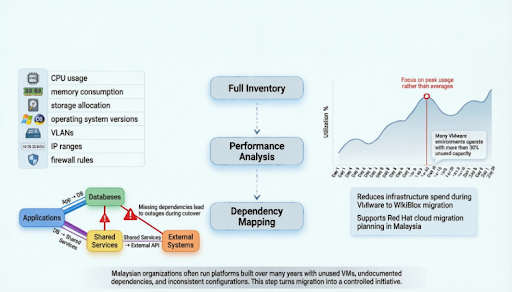
Every VMware to WikiBlox migration must start with a readiness assessment. This step creates visibility into the existing VMware environment. Many Malaysian organizations run platforms built over many years. These environments often include unused virtual machines, undocumented dependencies, and inconsistent configurations. A readiness assessment turns the VMware to WikiBlox migration into a controlled initiative.
Begin with a comprehensive inventory of all virtual machines. Record CPU utilization, memory consumption, storage allocation, and operating system versions. Network information such as VLAN configurations, IP ranges, and firewall policies should also be documented.
This data establishes the true scope of the migration and helps define the infrastructure requirements for the target platform.
Performance analysis provides additional insight for capacity planning. Review at least thirty days of utilization metrics to understand workload patterns. Priority should be given to peak usage levels rather than average consumption.
In many environments, this analysis reveals underutilized resources. Identifying these opportunities early helps organizations optimize infrastructure sizing during the migration process.
Dependency mapping completes this step. Applications depend on databases, shared services, and external systems. Document these relationships clearly. Missing dependencies lead to outages during cutover. A complete dependency map reduces risk and shortens recovery time.
Key Step 2. Design Architecture for VMware to WikiBlox Migration and Red Hat Cloud Migration Malaysia
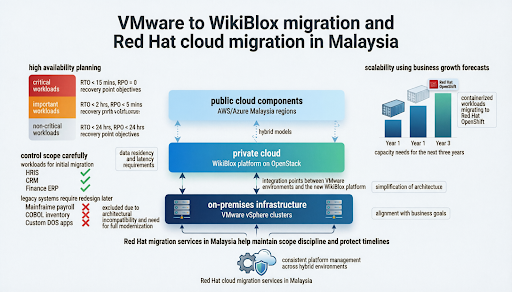
Architectural design plays a crucial role in determining the long-term success of VMware's WikiBlox migration. This step aligns technology with business goals. Many teams fail by moving workloads without redesigning how platforms should operate. The VMware to WikiBlox migration offers an opportunity to simplify the architecture and enhance resilience.
Define the deployment model early. Options include on-premises, private cloud, or hybrid designs. Many Malaysian organizations select hybrid models to meet data residency and latency requirements. Red Hat cloud migration in Malaysia supports hybrid environments through consistent platform management.
High availability planning must align with workload importance. Define recovery time and recovery point objectives for each system. Avoid applying the same availability level across all workloads. This approach increases cost without business value. VMware to WikiBlox migration benefits from a targeted availability design.
Plan for scalability using business growth forecasts. Estimate capacity needs for the next three years. Avoid assumptions. Proper forecasting prevents repeated expansion projects after the VMware to WikiBlox migration. VMware to Red Hat OpenShift migration planning often fits into this step to support container-based workloads.
Control scope carefully. Identify workloads for initial migration and those that remain. Some legacy systems require redesign later. Document exclusions clearly. Red Hat migration services in Malaysia help maintain scope discipline and protect timelines.
Key Step 3. Execute VMware to WikiBlox Migration Using Phased Red Hat Migration Services Malaysia
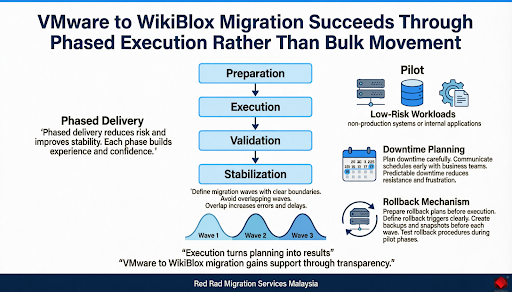
Execution turns planning into results. VMware to WikiBlox migration succeeds through phased execution rather than bulk movement. Phased delivery reduces risk and improves stability. Each phase builds experience and confidence.
Start with low-risk workloads. Non-production systems or internal applications make strong pilot candidates. These early migrations validate tools, processes, and runbooks. Teams refine execution steps during these phases. Early success builds trust in the VMware to WikiBlox migration.
Define migration waves with clear boundaries. Each wave includes preparation, execution, validation, and stabilization. Avoid overlapping waves. Overlap increases errors and delays. Red Hat migration services Malaysia often structure VMware to WikiBlox migration around disciplined wave delivery.
Plan downtime carefully. Some workloads require maintenance windows. Communicate schedules early with business teams. Predictable downtime reduces resistance and frustration. VMware to WikiBlox migration gains support through transparency.
Prepare rollback plans before execution. Define rollback triggers clearly. Create backups and snapshots before each wave. Test rollback procedures during pilot phases. VMware to WikiBlox migration moves faster when teams trust recovery options.
Key Step 4. Secure Governance for VMware to WikiBlox Migration and Red Hat Cloud Migration Malaysia
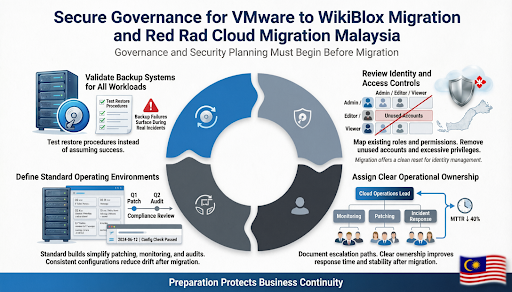
Governance and security planning must begin before migration. VMware to WikiBlox migration changes access patterns and operational workflows. Teams that delay governance face compliance gaps and operational confusion. Preparation protects business continuity.
Validate backup systems for all workloads. Test restore procedures instead of assuming success. Backup failures often surface only during real incidents. Verified backups provide confidence during VMware to WikiBlox migration cutovers.
Review identity and access controls. Map existing roles and permissions. Remove unused accounts and excessive privileges. Migration offers a clean reset for identity management. Red Hat cloud migration in Malaysia aligns well with structured access models.
Establish a Standard Operating Environment (SOE) framework. Standardized system builds simplify patching, monitoring, and compliance audits. Consistent configurations reduce configuration drift and help maintain governance after migration. Red Hat migration services in Malaysia often support organizations in implementing these operational standards. Consistent configurations reduce drift after the VMware to WikiBlox migration. Red Hat migration services in Malaysia often help enforce platform standards.
Assign clear operational ownership. Define responsibility for monitoring, patching, and incident response. Document escalation paths. Clear ownership improves response time and stability after migration.
Key Step 5. Optimize Operations After VMware to WikiBlox Migration and VMware to Red Hat OpenShift Migration
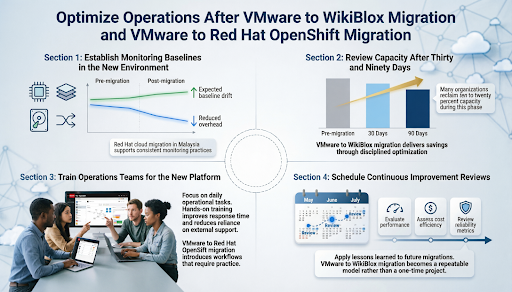
Post-migration optimization determines long-term value. VMware to WikiBlox migration does not end at cutover. Ongoing optimization improves performance and cost control. Teams that invest here see measurable returns.
Establish monitoring baselines in the new environment. Track CPU, memory, storage, and network metrics. Compare results against pre-migration data. Early detection of anomalies prevents service issues. Red Hat cloud migration in Malaysia supports consistent monitoring practices.
Review capacity after thirty and ninety days. Adjust allocations based on real usage. Many organizations discover additional unused capacity during this phase, allowing infrastructure resources to be optimized.VMware to WikiBlox migration delivers savings through disciplined optimization.
Train operations teams for the new platform. Focus on daily operational tasks. Hands-on training improves response time and reduces reliance on external support. VMware to Red Hat OpenShift migration introduces workflows that require practice.
Schedule continuous improvement reviews. Evaluate performance, cost, and reliability regularly. Apply lessons learned to future migrations. VMware to WikiBlox migration becomes a repeatable model rather than a one-time project.
Conclusion: Key Steps Preparing for a Smooth VMware Migration in Malaysia
VMware to WikiBlox migration in Malaysia succeeds through five clear steps. Assess readiness. Design the right architecture. Execute in phases. Secure governance. Optimize operations. Organizations that align VMware to WikiBlox migration with Red Hat cloud migration in Malaysia gain control and predictability. Red Hat migration services in Malaysia support each step. VMware to Red Hat OpenShift migration completes a platform ready for future growth.
Migrate Now to Wikiblox Malaysia: Modern Virtualisation for Malaysian Enterprises
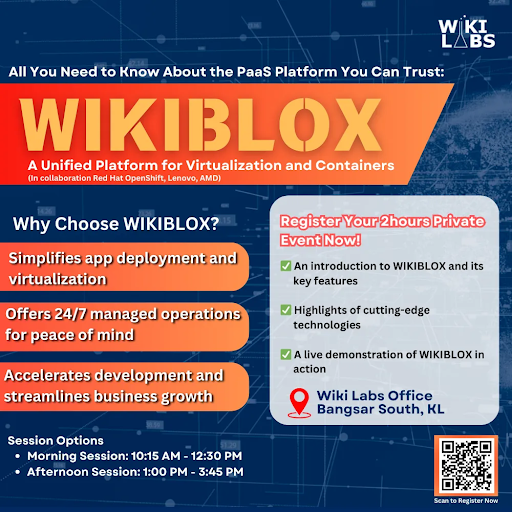
WikiBlox delivers a modern virtualisation foundation designed specifically for Malaysian enterprises. It unifies virtual machine and container workloads within a single platform, simplifying management, migration, and scalability.
Built with strong governance and operational best practices, WikiBlox helps organisations modernise their IT environments with confidence, WikiBlox helps organisations modernise their IT environments confidently. For enterprises evaluating VMware alternatives, it provides a future-ready platform developed and supported within Malaysia.
WikiBlox: What You Should Know
WikiBlox by Wiki Labs Sdn Bhd is engineered on an enterprise-grade architecture that integrates Red Hat OpenShift with Lenovo infrastructure powered by AMD EPYC processors, all operated within Malaysia. The platform unifies virtual-machine and container workloads under managed operations with built-in governance, security, and compliance aligned to Malaysian enterprise standards.
A recent local deployment within the financial services sector demonstrated significantly faster provisioning and measurable cost efficiencies compared with traditional virtualisation environments. For organisations exploring VMware alternatives, WikiBlox distinguishes itself through local support, regulatory alignment, and optimisation for hybrid-cloud and container workloads.
How Wiki Labs Helps Manage Virtualisation Costs
Wiki Labs provides full-lifecycle services for enterprise virtualisation — from assessing existing VMware environments to designing migration frameworks and optimising operations post-deployment.
Through cost-transparency analysis, predictable licensing models, and Malaysia-based support, Wiki Labs helps organisations identify and reduce hidden expenses associated with legacy systems. Its consultants offer clear insights into the total cost of ownership (TCO) across leading VMware alternatives, ensuring each client selects the most cost-effective and scalable approach for long-term growth.
With deep local expertise and platform-agnostic hardware integration, Wiki Labs enables Malaysian enterprises to achieve operational clarity and sustainable cost efficiency in their modernisation journey.
Ready to Move Forward with Modern VMware Alternatives?
WikiBlox isn’t just another platform. It’s your all-in-one foundation for Malaysia’s enterprise IT future.
👉 Schedule a free consultation with Wiki Labs experts today to see how WikiBlox can power your transformation.
Disclaimer:
The information in this article is provided for general informational purposes only. All product names, trademarks, and registered trademarks are the property of their respective owners. References to third-party technologies such as VMware, Red Hat, Lenovo, AMD, and others are made solely to describe compatibility or comparison context and do not imply any endorsement or affiliation.
Wiki Labs Sdn Bhd makes reasonable efforts to ensure the accuracy of information at the time of publication; however, readers are encouraged to verify technical details and licensing information directly with the respective vendors.
