BNM RMiT VMware Alternative Readiness Guide
Broadcom completed its acquisition of VMware on 22 November 2023. VMware by Broadcom later announced a simplified offer lineup and a transition from perpetual licensing toward subscription licensing. These changes have pushed financial institutions to review renewal exposure, platform dependency, support direction, and long term infrastructure control.
A BNM RMiT VMware Alternative review is not a normal procurement exercise. The decision must support leadership approval, risk review, internal audit, vendor due diligence, and operational resilience planning. The strongest decision does not rely on lower cost alone. It proves control over critical workloads, audit trails, data location, privileged access, recovery testing, and exit readiness.
What BNM RMiT VMware Alternative Evaluation Must Prove
Bank Negara Malaysia issued the updated Risk Management in Technology policy document on 1 June 2023. Public regulatory summaries state that the updated RMiT strengthens expectations around governance, cyber security, cloud technology risk, third party risk, multi factor authentication, and resilience. These requirements change how financial institutions should assess virtualisation and private cloud platforms.
BNM RMiT VMware Alternative Governance Pack Before Proof of Concept

A BNM RMiT VMware Alternative review should begin with a governance pack before any proof of concept. The pack gives board, senior management, risk, audit, procurement, security, and infrastructure teams a shared record of the business reason, risk reason, migration scope, workload impact, and approval path.
The governance pack should include these items.
Business and risk rationale:
Explain renewal pressure, vendor concentration, support continuity, operational resilience concerns, and long term platform control.Current VMware estate inventory:
Record host count, VM count, clusters, storage dependencies, network dependencies, backup tools, monitoring tools, licensing position, renewal date, and support status.Workload and service dependency map:
Classify core banking, payments, insurance, takaful, customer data, regulatory reporting, internet facing services, and internal systems by risk level. Add owner, RTO, RPO, migration priority, and rollback requirement.Governance and approval owners:
Assign ownership across CIO, CTO, CISO, risk, compliance, audit, and procurement. Each function reviews the control area linked to its responsibility.Migration control and evidence plan:
Prepare proof of concept results, security test records, backup validation, DR test results, access review evidence, change approvals, and rollback evidence before critical workload migration.
BNM RMiT VMware Alternative Platform Comparison for Regulated Institutions
A BNM RMiT VMware Alternative shortlist should compare each option by regulated operating risk, not feature count. The right platform must support secure operations, audit evidence, recovery testing, vendor accountability, workload portability, and future exit planning.
Table 1. Platform comparison
Second Filter: Approval Evidence
After platform comparison, apply this decision filter to move from technical preference to board-ready justification. The strongest choice is the platform your institution can operate, secure, test, document, and exit with confidence.
Table 2. Approval evidence filter
A BNM RMiT VMware alternative decision should not end with the platform that looks best in a feature matrix. It should end with the option your institution can operate, secure, test, document, and exit with confidence. Organisations evaluating Red Hat based VMware alternative strategies may benefit from implementation, migration, and operational support partners that can assist with governance preparation, platform assessment, migration planning, and operational readiness.
BNM RMiT VMware Alternative Vendor Questions for Risk and Procurement

After the platform comparison, the next step is vendor due diligence. A BNM RMiT VMware alternative should not move forward because it scores well in a feature table alone. Risk, procurement, security, audit, and infrastructure teams should test whether the vendor can support regulated workloads, provide clear accountability, and produce evidence during audits or incidents.
Use the questions below to turn the shortlist into a stronger approval paper.
Procurement note: Price is one part of the decision. A BNM RMiT VMware Alternative becomes board ready only when cost, migration risk, support quality, audit readiness, resilience testing, and exit flexibility support the same recommendation.
BNM RMiT VMware Alternative Next Steps for Board Ready Decisions
A BNM RMiT VMware Alternative decision should be closed with a recommendation that leadership, risk, audit, procurement, security, and infrastructure teams understand. Start with VMware estate inventory. Classify workloads by criticality. Build the risk assessment. Shortlist two or three platforms. Test security, logging, backup, access control, recovery, and rollback in a proof of concept.
The final choice should show how the institution will govern the platform, secure privileged access, produce audit evidence, meet recovery expectations, manage vendor accountability, and avoid a new dependency problem. The strongest BNM RMiT VMware Alternative is the platform that supports confident operation, testing, documentation, and exit planning.
WikiBlox: Malaysia’s Modern Approach to VMware Migration Alternative Service Providers Malaysia
WikiBlox delivers a modern virtualisation foundation designed specifically for Malaysian enterprises. It unifies virtual machine and container workloads within a single platform, simplifying management, migration, and scalability.
Built around strong governance and local compliance frameworks, WikiBlox helps organisations modernise their IT environments confidently. For enterprises evaluating VMware alternatives, it provides a future-ready platform developed and supported within Malaysia.
WikiBlox: What You Should Know
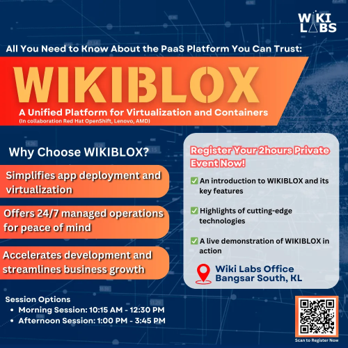
WikiBlox by Wiki Labs Sdn Bhd is engineered on an enterprise-grade architecture that integrates Red Hat OpenShift with Lenovo infrastructure powered by AMD EPYC processors, all operated within Malaysia. The platform unifies virtual-machine and container workloads under managed operations with built-in governance, security, and compliance aligned to Malaysian enterprise standards.
A recent local deployment within the financial services sector demonstrated significantly faster provisioning and measurable cost efficiencies compared with traditional virtualisation environments. For organisations exploring VMware alternatives, WikiBlox distinguishes itself through local support, regulatory alignment, and optimisation for hybrid-cloud and container workloads.
How Wiki Labs Helps Manage Virtualisation Costs
Wiki Labs provides full-lifecycle services for enterprise virtualisation — from assessing existing VMware environments to designing migration frameworks and optimising operations post-deployment.
Through cost-transparency analysis, predictable licensing models, and Malaysia-based support, Wiki Labs helps organisations identify and reduce hidden expenses associated with legacy systems. Its consultants offer clear insights into the total cost of ownership (TCO) across leading VMware alternatives, ensuring each client selects the most cost-effective and scalable approach for long-term growth.
With deep local expertise and platform-agnostic hardware integration, Wiki Labs enables Malaysian enterprises to achieve operational clarity and sustainable cost efficiency in their modernisation journey.
Ready to Move Forward with Modern VMware Alternatives?
WikiBlox isn’t just another platform. It’s your all-in-one foundation for Malaysia’s enterprise IT future.
👉 Schedule a free consultation with Wiki Labs experts today to see how WikiBlox can power your transformation.
Disclaimer:
The information in this article is provided for general informational purposes only. All product names, trademarks, and registered trademarks are the property of their respective owners. References to third-party technologies such as VMware, Red Hat, Lenovo, AMD, and others are made solely to describe compatibility or comparison context and do not imply any endorsement or affiliation.
Wiki Labs Sdn Bhd makes reasonable efforts to ensure the accuracy of information at the time of publication; however, readers are encouraged to verify technical details and licensing information directly with the respective vendors.
