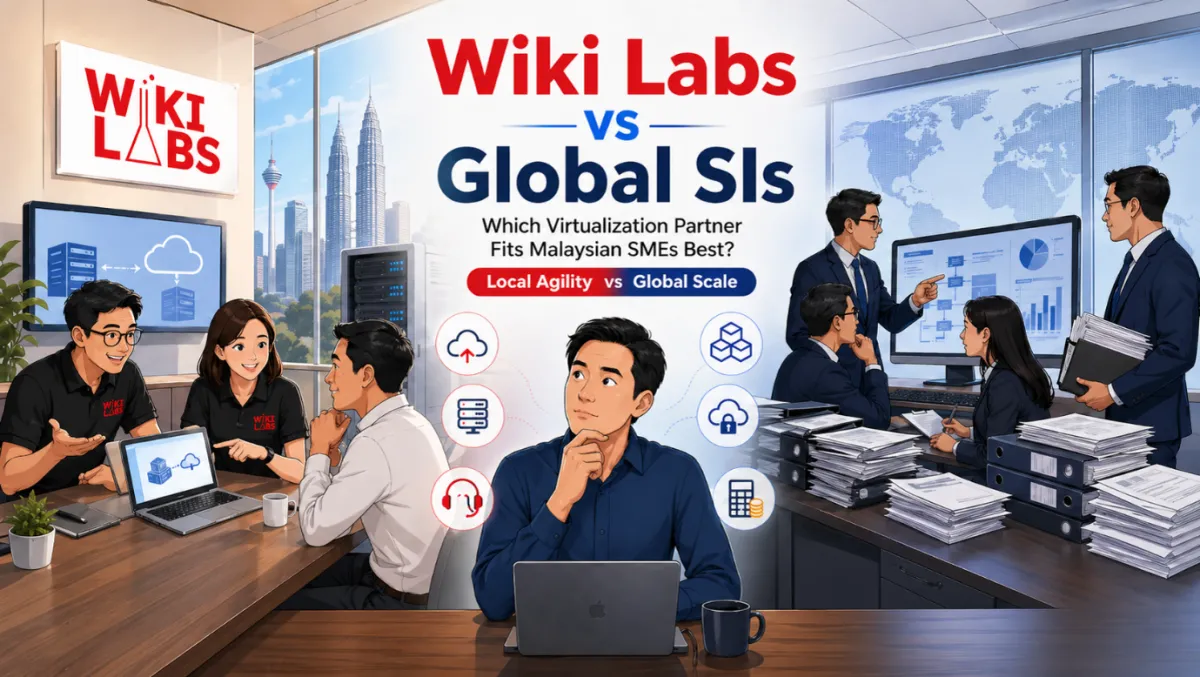
Choosing the Right Virtualization Partner for Malaysian Organizations: Wiki Labs vs Global SIs
Choosing the right virtualization and infrastructure modernization partner has become increasingly important for Malaysian organizations reviewing VMware dependency, hybrid cloud strategy, operational support models, and long-term infrastructure cost management.
Different delivery models offer different strengths. Large global system integrators often provide broad regional scale, standardized governance structures, and multinational delivery capability, while local infrastructure specialists may offer closer operational engagement, faster response coordination, and more localized support flexibility depending on the organization’s operational requirements.
The most suitable approach often depends on factors such as workload criticality, operational complexity, internal IT capability, compliance requirements, migration objectives, downtime tolerance, and long-term infrastructure growth plans.
Many organizations continue relying on virtualized environments to support business-critical applications across finance, operations, customer management, internal systems, and day-to-day infrastructure operations. In these environments, partner selection can directly affect migration planning, operational continuity, support responsiveness, governance visibility, and long-term infrastructure sustainability.
Wiki Labs vs Global SIs: Why Malaysian Organizations Need the Right Virtualization Partner
Malaysian organizations increasingly require virtualization partners that understand both technical infrastructure requirements and operational business realities. Virtualized environments continue supporting critical workloads across finance, operations, customer service, reporting systems, internal applications, and day-to-day business operations.
As infrastructure environments become more complex, issues such as rising operational costs, aging virtualization platforms, migration planning challenges, and ongoing support requirements can directly affect operational continuity, workload stability, and long-term infrastructure scalability.
For many organizations operating with lean internal IT teams and evolving infrastructure demands, partner selection becomes an important operational decision. Organizations increasingly require practical infrastructure assessment, realistic modernization planning, controlled migration execution, operational governance, and ongoing support capability beyond the initial deployment phase.
Different infrastructure delivery models offer different strengths. Large global system integrators often provide broader regional scale and standardized governance structures, while local infrastructure specialists may offer closer operational coordination, more responsive support engagement, and localized delivery flexibility depending on organizational requirements.
Ultimately, the most suitable virtualization partner is not necessarily the largest provider, but the one best aligned with the organization’s workload requirements, operational priorities, internal capability, governance expectations, and long-term modernization strategy.
Wiki Labs vs Global SIs: What Global SIs Offer in Virtualization and Cloud Modernization
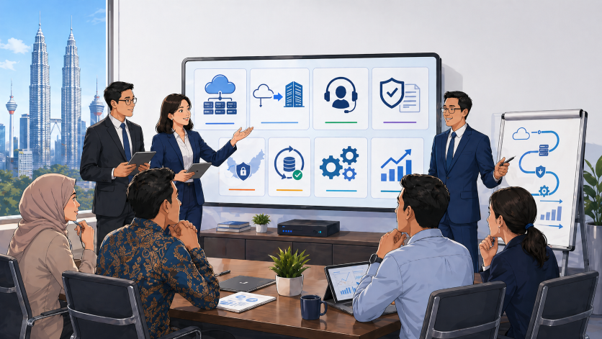
Global SIs bring large delivery teams, structured project methods, multi-vendor experience, and strong governance. They are built for organizations with complex infrastructure, multiple locations, strict audit requirements, and long transformation roadmaps. Their model works well when a company needs formal planning, deep documentation, managed services, and coordination across many technical teams.
A Global SI often suits banks, telcos, MNCs, regional groups, and companies managing large data centre environments. These organizations usually need enterprise governance, multi-cloud strategy, compliance control, and long-term managed service coverage. For Malaysian SMEs, these strengths still have value, but only when the project size, budget, and internal capacity justify that level of delivery.
The challenge is fit. Many SMEs do not need a broad transformation program before they improve virtualization, reduce VMware dependency, or modernize workloads. They need a partner that can simplify the decision, explain the trade-offs, protect uptime, and build a path that the business can afford and manage. This makes the Wiki Labs vs Global SIs comparison more practical than a simple choice between a global name and a local provider.
Wiki Labs vs Global SIs: Why Global SIs Do Not Always Fit Malaysian SMEs
Many SMEs need a focused virtualization plan, not a full transformation program. A Global SI engagement often starts with broad discovery, formal governance, layered approvals, and a larger delivery scope. These steps support complex enterprise projects, but they can slow down SMEs that need faster assessments, practical migrations, and clear cost control. Wiki Labs vs Global SIs helps SMEs ask whether the proposed model solves the infrastructure problem or creates a bigger project than the business needs.
The main issue is not capability. Global SIs have strong technical depth, but their delivery model may not match SME reality. A smaller company often has a lean IT team, limited internal documentation, and a tighter budget for migration, support, and training. If the partner designs for enterprise maturity while the SME still needs basic operational clarity, the result can be more tools, more meetings, and more cost without enough day-to-day value.
SMEs should also question ownership after the migration. A project can look successful during deployment but fail later when the internal team cannot manage the platform confidently. The right partner should provide practical documentation, knowledge transfer, escalation paths, and post-migration support that match the SME’s actual team size. This makes Wiki Labs vs Global SIs a discussion about long-term manageability, not only project delivery.
There is also a research gap worth exploring. Many virtualization decisions focus on platform features, vendor reputation, and migration cost, but SMEs should also measure business fit, support responsiveness, knowledge transfer, downtime impact, and total cost after deployment. Future comparison research should study how local specialists and Global SIs perform across these practical areas. This would give Malaysian SMEs a clearer way to choose a virtualization partner based on measurable business outcomes, not brand perception alone.
Wiki Labs vs Global SIs: How Wiki Labs Supports SME Virtualization Needs
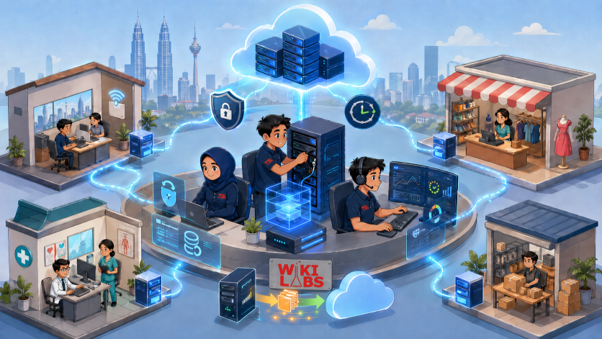
Wiki Labs Sdn Bhd fits the local specialist role for Malaysian SMEs seeking practical virtualization modernization. Its value comes from local implementation focus, clear communication, and guidance across VMware alternatives, OpenShift Virtualization, hybrid infrastructure, and workload planning. Wiki Labs vs Global SIs is useful here because many SMEs need a partner that understands local budgets, support expectations, business risk, and the pressure to modernize without disrupting daily operations.
Wiki Labs Sdn Bhd helps SMEs look beyond short-term infrastructure fixes and plan a more manageable modernization path. Instead of pushing a large transformation model, the focus is on assessing current workloads, identifying migration priorities, reducing risk, and building a platform direction that supports both today’s virtual machines and future application needs. This gives SMEs a more practical route when they want to improve cost control, uptime, and infrastructure flexibility.
A strong part of this direction is Red Hat OpenShift Virtualization. Wiki Labs Sdn Bhd positions its VMware alternative work around helping Malaysian organizations move from traditional VM operations toward a platform that supports both VMs and containers. This makes the Wiki Labs vs Global SIs comparison valuable for SMEs that want local support, clearer ownership, and a modernization partner that can guide them step by step.
Wiki Labs vs Global SIs: Key Comparison for Malaysian SMEs
Wiki Labs vs Global SIs should start with business fit. Global SIs such as Accenture, Kyndryl, DXC Technology, and NTT DATA bring strong enterprise delivery for large infrastructure programs. For Malaysian SMEs, the stronger question is whether the partner can match the project to the company’s workload size, budget, support needs, and internal IT capability.
The realistic takeaway is simple: Global SIs lead when the business needs scale, regional delivery, complex governance, and large transformation control. Wiki Labs Sdn Bhd leads for Malaysian SMEs when the priority is practical virtualization modernization, local support, cost control, VMware alternative guidance, and a platform direction that the internal team can manage.
Wiki Labs vs Global SIs: Beyond Brand Size, How SMEs Avoid the Wrong Virtualization Partner

A well known provider name does not guarantee the right virtualization outcome. SMEs should look beyond brand size and ask whether the partner understands their workloads, business hours, backup process, internal skills, budget limits, and downtime tolerance. Wiki Labs vs Global SIs helps shift the decision from “who is bigger” to “who is better suited to support this business.”
Cost should never start and end with a migration quote. SMEs need to review licensing, implementation, hardware, cloud resources, support, training, backup, monitoring, and future expansion. A cheaper starting price can become expensive when support is unclear, tools are unnecessary, or the internal team needs extra help after deployment.
Downtime planning also needs clear ownership. A reliable virtualization partner should map workload dependencies, test migration steps, prepare backup, define rollback, and confirm who approves the final cutover. If the migration plan sounds too broad or too technical for the SME team to manage, the partner should simplify the plan before the project starts.
Support after migration is where the real value of a virtualization partner becomes clear. SMEs should know who answers incidents, how escalation works, what response time applies, and who remains accountable after the platform goes live, and Wiki Labs Sdn Bhd gives businesses a practical place to start if they want to learn more about local virtualization support, VMware alternatives, and OpenShift Virtualization for Malaysian SMEs.
Wiki Labs vs Global SIs: Conclusion, The Best Virtualization Partner Fits SME Reality
Wiki Labs vs Global SIs is not a contest between small and large providers. It is a decision about fit, cost, risk, support, and modernization pace. Global SIs remain valuable for large, complex, multi-country transformations, while Wiki Labs Sdn Bhd offers a more focused route for Malaysian SMEs reviewing virtualization, VMware alternatives, and OpenShift Virtualization.
For SMEs, the right virtualization partner should make infrastructure decisions easier to manage. The partner should explain the options clearly, protect uptime, control costs, and support the team after deployment. Wiki Labs vs Global SIs points to a practical verdict: choose the partner that understands your business reality, supports your current systems, and helps you modernize at a pace your team can manage.
WikiBlox: Malaysia’s Modern Approach to VMware Migration Alternative Service Providers Malaysia
WikiBlox delivers a modern virtualisation foundation designed specifically for Malaysian enterprises. It unifies virtual machine and container workloads within a single platform, simplifying management, migration, and scalability.
Built around strong governance and local compliance frameworks, WikiBlox helps organisations modernise their IT environments confidently. For enterprises evaluating VMware alternatives, it provides a future-ready platform developed and supported within Malaysia.
WikiBlox: What You Should Know
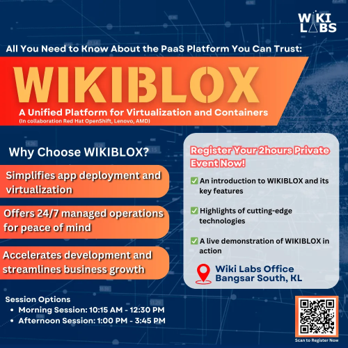
WikiBlox by Wiki Labs Sdn Bhd is engineered on an enterprise-grade architecture that integrates Red Hat OpenShift with Lenovo infrastructure powered by AMD EPYC processors, all operated within Malaysia. The platform unifies virtual-machine and container workloads under managed operations with built-in governance, security, and compliance aligned to Malaysian enterprise standards.
A recent local deployment within the financial services sector demonstrated significantly faster provisioning and measurable cost efficiencies compared with traditional virtualisation environments. For organisations exploring VMware alternatives, WikiBlox distinguishes itself through local support, regulatory alignment, and optimisation for hybrid-cloud and container workloads.
How Wiki Labs Helps Manage Virtualisation Costs
Wiki Labs provides full-lifecycle services for enterprise virtualisation — from assessing existing VMware environments to designing migration frameworks and optimising operations post-deployment.
Through cost-transparency analysis, predictable licensing models, and Malaysia-based support, Wiki Labs helps organisations identify and reduce hidden expenses associated with legacy systems. Its consultants offer clear insights into the total cost of ownership (TCO) across leading VMware alternatives, ensuring each client selects the most cost-effective and scalable approach for long-term growth.
With deep local expertise and platform-agnostic hardware integration, Wiki Labs enables Malaysian enterprises to achieve operational clarity and sustainable cost efficiency in their modernisation journey.
Ready to Move Forward with Modern VMware Alternatives?
WikiBlox isn’t just another platform. It’s your all-in-one foundation for Malaysia’s enterprise IT future.
👉 Schedule a free consultation with Wiki Labs experts today to see how WikiBlox can power your transformation.
Disclaimer:
The information in this article is provided for general informational purposes only. All product names, trademarks, and registered trademarks are the property of their respective owners. References to third-party technologies such as VMware, Red Hat, Lenovo, AMD, and others are made solely to describe compatibility or comparison context and do not imply any endorsement or affiliation.
Wiki Labs Sdn Bhd makes reasonable efforts to ensure the accuracy of information at the time of publication; however, readers are encouraged to verify technical details and licensing information directly with the respective vendors.
