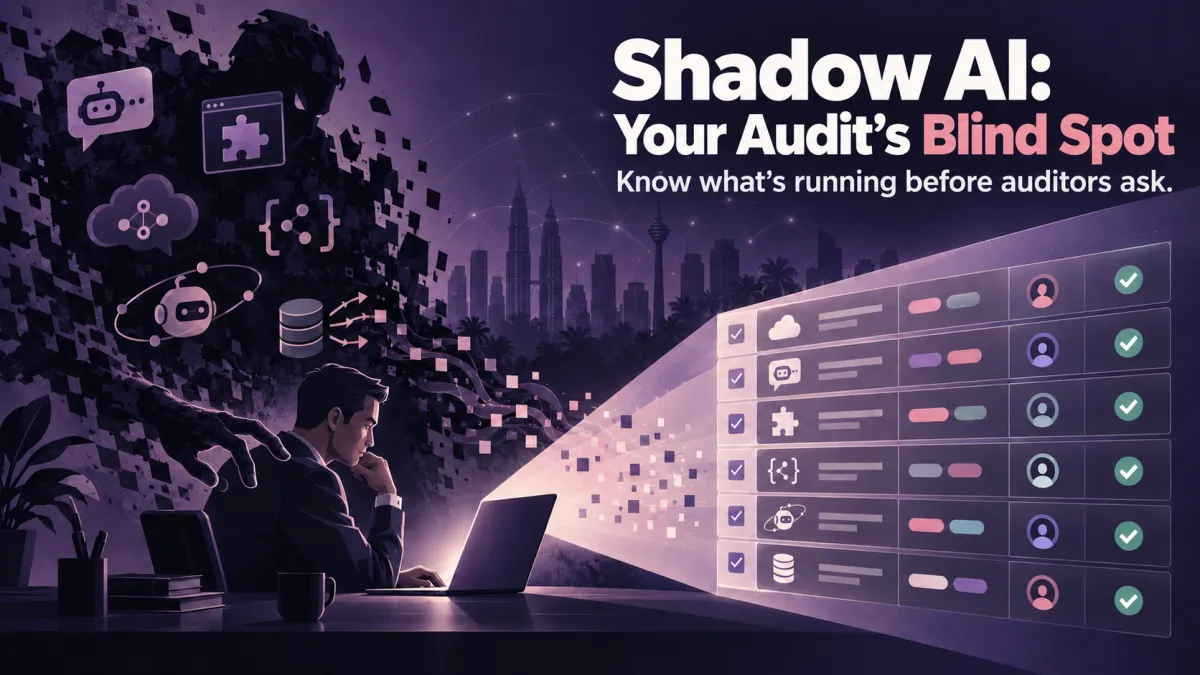
AI Inventory Malaysia: Why Shadow AI Governance Must Start Before Your Next Audit
Your organization may have an AI policy, an approved chatbot and security controls. But can it answer a basic audit question: Which AI systems are actually being used?
A marketer might upload customer data to a public chatbot, a developer might connect an external model API, or an approved CRM might activate a new AI assistant. These activities can remain invisible to procurement records and conventional software inventories.
An AI inventory Malaysia strategy must therefore begin with discovery. Before an enterprise can govern or audit AI, it needs a reliable record of the tools, embedded features and agents operating across the business.
Microsoft and LinkedIn reported that 78% of AI users bring their own tools to work, rising to 80% at small and medium-sized companies. Although global, the finding shows why approved usage provides an incomplete picture.
What Is Shadow AI And Why Is It Hard To See?

Shadow AI is the use or operation of AI tools, models, features or agents without appropriate organizational visibility, approval or monitoring. It includes more than employees opening personal chatbot accounts.
Common examples include:
Public generative AI tools used with company information
AI writing, meeting or design features embedded in approved SaaS products
Browser extensions and plugins connected to business accounts
Developer-created model APIs and experimental applications
AI agents that read data, call tools or modify company records
The Shadow AI Malaysia conversation must extend beyond public chatbots. AI can arrive through approved software, while an experimental integration can quietly become a production dependency.
The risk becomes more complex when AI can take actions. Agents may access databases, send messages and update records using permissions inherited from their creators. Wiki Labs’ framework for governing AI agents in regulated Malaysian enterprises explains the additional controls needed for agent identity, permission boundaries, monitoring and audit trails.
Why Shadow AI Breaks Audit Readiness

An audit can only test systems within its scope. When the AI population is incomplete, controls may cover only the visible portion of the risk. A sound AI inventory Malaysia program connects each use case to its owner, data, provider, permissions and evidence.
Unknown Data Flows
Employees may enter personal, financial, source-code or confidential information into an external service. Whether inputs are retained or used for training depends on the product, account, settings and contract. Without a system record, the organization may not know what to investigate.
Missing Ownership And Evidence
A policy requiring approved AI is not proof that the rule operates effectively. Auditors may ask who approved a system, what data it processes, how its provider was assessed and which controls were tested. Without an owner, those questions travel between departments without a defensible answer.
Incomplete Third-Party Oversight
External AI and cloud providers do not remove enterprise accountability. Contracts, data locations, access controls, audit rights and evidence still require review. These criteria for evaluating cloud infrastructure vendors in Malaysia provide a starting point for sensitive workloads.
For an AI audit Malaysia team, the central question is straightforward: Can management list every relevant AI system, identify its owner, explain its data use and show that the risk was assessed?
What Makes An AI Inventory Malaysia Program Audit-Ready?
An AI inventory is a controlled, continuously maintained record of the AI systems and AI-enabled capabilities an organization develops, purchases, embeds or uses. It is not simply a list of approved chatbots or a spreadsheet produced days before an audit.
A practical AI inventory Malaysia record should include:
For cloud-hosted AI, record where prompts, outputs, logs, backups and recovery copies are stored or accessed. Wiki Labs’ guide to data residency in Malaysia explains why selecting a Malaysian cloud region alone does not answer every governance question.
Unlike a model registry, data catalog or IT inventory, the AI inventory connects technical assets to the complete business use case.
The NIST Generative AI Profile is particularly useful here. Its Govern 1.6 outcome calls for mechanisms to inventory AI systems and suggests recording data provenance, known issues, human oversight, sensitive-data considerations, underlying models, versions and access modes.
How To Build An AI Inventory Malaysia Register In Five Steps
1. Define What Counts As AI
Define the scope before approaching departments. Include machine learning, generative AI, embedded copilots, model APIs, plugins, internal AI applications, automation and autonomous agents. Include pilots that process real data or influence real work.
2. Discover What Is Actually Being Used
Combine employee and technical discovery. Review workflows, procurement and expense records, SaaS sign-ins, endpoint and network activity, cloud services, code repositories and DLP alerts. Ask vendors whether AI features have been added.
No scanner provides complete visibility. Network controls may miss local models and offline work, while interviews may miss plugins or developer integrations. The AI inventory Malaysia process should reconcile multiple sources and document its limitations.
3. Assign Accountable Owners
Every entry needs a business owner for the purpose and outcome, plus a technical owner for operation and security. Privacy, legal, procurement or risk teams should review sensitive or consequential systems.
4. Classify The Risk
Use simple tiers. Low-risk tools may process public information with human review. Moderate-risk systems may handle internal information. High-risk systems may process sensitive data, influence consequential decisions, access critical systems or act autonomously.
Risk classification turns the AI inventory Malaysia record into a decision tool. It helps teams prioritize detailed reviews instead of applying the same lengthy process to every spelling assistant, forecasting model and customer-facing agent.
5. Approve, Restrict Or Retire
Give every system a documented outcome: approved, approved with conditions, transferred, restricted, sandboxed, suspended or retired. New procurement, material changes and deployments should trigger updates.
This is where AI governance Malaysia moves from policy to practice by giving useful tools a route to become safe, supported and accountable.
How An AI Inventory Supports Malaysian Governance

Malaysia does not impose one universal AI inventory requirement on every organization. An inventory instead supports applicable laws, sector rules and voluntary frameworks.
Malaysia’s Personal Data Protection Act
Malaysia’s PDPA applies where relevant personal data is processed in commercial transactions. It does not expressly require every company to maintain an AI inventory. An AI inventory Malaysia approach nevertheless identifies which systems process personal data, which providers receive it, where it travels and who owns incident response.
That makes the inventory a practical PDPA AI compliance mechanism, not a standalone statutory obligation. Where applicable, a strong PDPA AI compliance process can also help the Data Protection Officer coordinate assessments, records and breach response.
Malaysia’s AIGE Guidance
Malaysia’s voluntary National Guidelines on AI Governance and Ethics establish seven principles, including fairness, reliability, privacy and security, transparency and accountability.
An inventory gives AI governance Malaysia teams a defined population against which those principles can be applied.
Bank Negara Malaysia’s RMiT Framework
BNM’s RMiT requirements apply to financial institutions within scope, not every Malaysian business. The policy emphasizes technology governance, asset visibility, APIs, cloud risk, data protection and third-party oversight. An AI inventory can connect use cases to those controls.
For an AI audit Malaysia review, this mapping is more defensible than claiming RMiT creates a universal AI-specific inventory obligation.
NIST provides explicit inventory guidance, while ISO/IEC 42001 supports an organization-wide AI management system. Both can strengthen AI governance Malaysia without misrepresenting voluntary guidance as Malaysian law.
A 30-Day Pre-Audit Action Plan
Week 1: Define And Prepare
Appoint an executive sponsor, define the scope, choose the inventory owner and prepare a standard intake form.
Week 2: Discover And Reconcile
Run technical discovery and business-unit workshops. Compare the results with procurement, vendor, software and data records.
Week 3: Prioritize And Treat
Assign owners, identify sensitive information and escalate high-risk systems. Contain obvious exposures immediately rather than waiting for the complete assessment.
Week 4: Produce Audit Evidence
Document approvals, restrictions, exceptions and remediation plans. Preserve a dated inventory version, the discovery methodology and management sign-off. For the AI audit Malaysia process, this provides evidence of both the known environment and the work underway to address gaps.
Thirty days can produce a defensible first AI inventory Malaysia baseline. It cannot create permanent visibility. The register must be updated whenever a system is introduced, materially changed or retired, with periodic reviews to test completeness.
Visibility Must Come Before Control
Shadow AI is fundamentally a visibility and accountability problem. A well-maintained AI inventory Malaysia program connects each system to its purpose, owner, data, provider, risks, controls and evidence.
The objective is not to prevent useful AI adoption. It is to move valuable experimentation into approved, supportable and auditable workflows. The enterprise that builds its inventory before the audit can explain and improve its risks. The enterprise that waits may discover its AI environment for the first time in front of the auditor.
WikiBlox: What You Should Know

WikiBlox is the platform Wiki Labs runs a rebuilt SOE on, not a separate product added after migration. It combines Red Hat OpenShift with Lenovo hardware and AMD EPYC processors, hosted and supported inside Malaysia. Every WikiBlox deployment ships with a golden image pipeline built in, so a rebuilt SOE inherits standardized hardening and version control from the first day instead of waiting on a second project to add it.
Because WikiBlox runs on OpenShift Virtualization, the golden image work covered in this playbook maps directly onto the platform your team is already committed to. Teams rebuilding their SOE this way skip the gap between choosing a platform and proving it meets RMiT and PDPA controls, since both get validated together instead of as two separate workstreams.
How Wiki Labs Helps Manage Virtualisation Costs
Wiki Labs Sdn Bhd provides full-lifecycle services for enterprise virtualisation, from assessing existing VMware environments to designing migration frameworks and optimising operations post-deployment.
Through cost-transparency analysis, predictable licensing models, and Malaysia-based support, Wiki Labs helps organisations identify and reduce hidden expenses associated with legacy systems. Its consultants offer clear insights into the total cost of ownership across leading VMware alternatives, ensuring each client selects the most cost-effective and scalable approach for long-term growth.
With deep local expertise and platform-agnostic hardware integration, Wiki Labs enables Malaysian enterprises to achieve operational clarity and sustainable cost efficiency in their modernisation journey.
Ready to Move Forward with Modern VMware Alternatives?
WikiBlox isn’t just another platform. It’s your all-in-one foundation for Malaysia’s enterprise IT future.
👉 Schedule a free consultation with Wiki Labs experts today to see how WikiBlox can power your transformation.
Disclaimer:
The information in this article is provided for general informational purposes only. All product names, trademarks, and registered trademarks are the property of their respective owners. References to third-party technologies such as VMware, Red Hat, Lenovo, AMD, and others are made solely to describe compatibility or comparison context and do not imply any endorsement or affiliation.
Wiki Labs Sdn Bhd makes reasonable efforts to ensure the accuracy of information at the time of publication; however, readers are encouraged to verify technical details and licensing information directly with the respective vendors.
