Low-Cost VMware Substitute Options For Malaysian Enterprises (2026)
For many Malaysian enterprises, the question is no longer whether to move away from VMware—it's how to reduce virtualisation costs without increasing operational risk. Following changes to VMware licensing and commercial models, many organisations are reassessing their long-term infrastructure strategy and evaluating a low-cost VMware substitute that aligns with both technical and business requirements.
Licensing costs are only one part of the equation. Long-term support, backup capabilities, migration complexity, operational governance and internal skill requirements often have a much greater impact on the total cost of ownership. In some environments, renewing VMware for another term while preparing a phased migration strategy may still be the lowest-risk approach.
This guide compares four of the most widely evaluated low-cost VMware substitutes—Proxmox VE, Microsoft Hyper-V, Red Hat OpenShift Virtualization and Nutanix AHV—to help Malaysian organisations understand where each platform excels, where hidden operational costs may arise, and which option best supports long-term infrastructure modernisation.
Best Low-Cost VMware Alternatives at a Glance
Use this to pick the first platform to test. A proof of concept on representative production workloads settles the final choice.
Why Malaysian Enterprises Need A Low-Cost VMware Substitute Now
Following Broadcom's acquisition of VMware, VMware licensing shifted from perpetual licences for new purchases to subscription-based offerings. Current quotes are commonly calculated per core, with a sixteen-core minimum applied to each physical processor. That means a dual-socket server with two eight-core processors can be billed as thirty-two cores. Always confirm the current SKU, core count and term in the written quote because commercial conditions have changed more than once.
Malaysian buyers carry another cost that global comparisons often miss. VMware subscriptions are quoted in US dollars, while budgets and approvals are usually managed in ringgit. Exchange-rate movement therefore sits on the same invoice as licensing changes. A fair comparison must model the three-year cost in MYR, including support, staffing, backup, hardware reuse and migration labour.
The True Cost of a Low-Cost VMware Substitute in 2026

License price is the smallest line. Four blocks decide whether a low-cost VMware substitute saves money over three years.
Licensing Model, Not Licence Price
Proxmox VE is free under AGPLv3. The optional subscription bills per occupied CPU socket, with 2026 net tiers on the Proxmox pricing page running from 120 to 1,100 euros. Sockets, not cores: a 64 core and a 4 core processor cost the same. VMware bills every core and rounds each CPU up to sixteen. A three node cluster of single socket hosts runs 1,650 euros a year on Proxmox Standard. Under VMware's per-core licensing model, the same environment may be licensed for a minimum of 48 cores, depending on the applicable subscription terms.
The Support Window Nobody Prices
Proxmox enterprise support runs Austrian business days, 07:00 to 17:00 CET. In Malaysia the window opens near 14:00 and closes around midnight. Your afternoon is covered, your working morning is not. A 09:00 incident in the Klang Valley waits four hours for first response, and the community tier includes no tickets and no SLA.
Skills Decide More Than Licences
No low-cost VMware substitute stays cheap when you build a new team around it. Proxmox rewards Linux and Ceph depth, Hyper-V rewards Windows administrators you already employ, and OpenShift Virtualization needs platform engineering. Match the platform to the staff you have, not the staff you plan to hire.
Backup And Migration Labour
Backup is a gate, not a line item. Confirm platform, guest operating systems and recovery features against your backup product before shortlisting. Migration cost covers discovery, dependency mapping, VirtIO drivers, UEFI settings, conversion, testing, cutover and rollback. Budget hours per VM, multiply by your estate, add your downtime cost per hour.
Four Low-Cost VMware Substitute Options Compared
Proxmox VE Suits Teams With Real Linux Depth

Proxmox VE gives the strongest software cost advantage when your team already runs Linux in production. KVM, LXC, clustering and high availability ship in one interface, billed per socket instead of per core. The platform is production ready. The open question is whether your operating model is.
Hyper-V Suits Windows Estates With A Microsoft Agreement

Windows Server Datacenter grants unlimited Windows Server VMs once every physical core on the host is licensed. Most guides present this as a reason to choose Hyper-V. It is not. Microsoft licenses those rights to the server, not the hypervisor, so a Windows Server Datacenter estate already holds them on ESXi. The real Hyper-V saving is the hypervisor itself, included in Windows Server, which deletes the VMware line.
OpenShift Virtualization Suits Regulated Workloads

Red Hat OpenShift Virtualization runs VMs on KVM through KubeVirt, with the Migration Toolkit for Virtualization included for VMware imports. Financial services in BNM RMiT scope need audit trails and documented resilience. The policy revised on 28 November 2025 raised the bar on third party risk.
Red Hat OpenShift Virtualization vs VMware turns on one question. Do you have a platform team, or will Kubernetes become a committee? Wiki Labs Sdn Bhd is a Red Hat Premier Partner in Malaysia with an AppDev Specialization, builds Wikiblox on OpenShift, and still sends estates running only VMs to Proxmox first.
Nutanix AHV Suits Integrated Commercial HCI

Choose Nutanix AHV when one vendor should own compute, storage and management, with one escalation path at 3am. AHV bundles into the Nutanix subscription and operating expense stays higher than Proxmox by design. For some boards a low-cost VMware substitute matters less than a name on the contract.
Migration And Backup Decide Your Low-Cost VMware Substitute
Confirm Backup Support Before The Proof Of Concept
Veeam added Proxmox VE in Backup and Replication 12.2 and documents support for 8.2 through 9.1 from the official ISO, with agentless snapshot backup. Cross cluster replication and LXC containers stay unsupported. Check the matrix the day you decide, because version lists move.
Test more than a backup. Your proof of concept covers full VM recovery, file level recovery, application consistent recovery, off site copies, immutability, retention and restore time. If the recovery method changes, price the new process and the training.
Migrate In Waves, Not In One Weekend
Wave migration beats a big weekend. Start with low risk workloads, validate performance and backup, then move business critical systems once proven. Reusing existing hardware adds a second pattern: evacuate and rebuild hosts one at a time. Other estates need parallel hardware or temporary capacity, and the cost belongs in the budget.
Windows guests need VirtIO drivers before conversion. Test UEFI settings, network mappings, storage performance and application dependencies. Keep the original VM or a verified recovery copy until the application owner signs off.
When Staying On VMware Beats Every Low-Cost VMware Substitute
Some estates should not migrate in 2026. Virtualization without vendor lock-in reads like an open source promise until you price the rebuild. Heavy dependence on NSX microsegmentation, vSAN or certified virtual appliances makes replacement dearer than another renewal term, because rebuilding security policy and recertifying applications consumes years of projected savings.
Renew with a defined exit plan instead of renewing by default. A priced alternative, a workload inventory and a tested proof of concept give you real bargaining power. Wikiblox, our own OpenShift platform, is the wrong answer for an estate running only VMs with no container roadmap. Our recommendation is always based on the workload, operational requirements and long-term business objectives, rather than the platform itself.
WikiBlox: What You Should Know
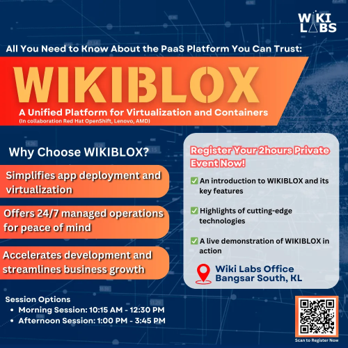
WikiBlox by Wiki Labs Sdn Bhd is engineered on an enterprise-grade architecture that integrates Red Hat OpenShift with Lenovo infrastructure powered by AMD EPYC processors, all operated within Malaysia. The platform unifies virtual-machine and container workloads under managed operations with built-in governance, security, and compliance aligned to Malaysian enterprise standards.
A recent local deployment within the financial services sector demonstrated significantly faster provisioning and measurable cost efficiencies compared with traditional virtualisation environments. For organisations exploring VMware alternatives, WikiBlox distinguishes itself through local support, regulatory alignment, and optimisation for hybrid-cloud and container workloads.
How Wiki Labs Helps Manage Virtualisation Costs
Wiki Labs provides full-lifecycle services for enterprise virtualisation — from assessing existing VMware environments to designing migration frameworks and optimising operations post-deployment.
Through cost-transparency analysis, predictable licensing models, and Malaysia-based support, Wiki Labs helps organisations identify and reduce hidden expenses associated with legacy systems. Its consultants offer clear insights into the total cost of ownership (TCO) across leading VMware alternatives, ensuring each client selects the most cost-effective and scalable approach for long-term growth.
With deep local expertise and platform-agnostic hardware integration, Wiki Labs enables Malaysian enterprises to achieve operational clarity and sustainable cost efficiency in their modernisation journey.
Ready to Move Forward with Modern VMware Alternatives?
WikiBlox isn’t just another platform. It’s your all-in-one foundation for Malaysia’s enterprise IT future.
👉 Schedule a free consultation with Wiki Labs experts today to see how WikiBlox can power your transformation.
Disclaimer:
The information in this article is provided for general informational purposes only. All product names, trademarks, and registered trademarks are the property of their respective owners. References to third-party technologies such as VMware, Red Hat, Lenovo, AMD, and others are made solely to describe compatibility or comparison context and do not imply any endorsement or affiliation.
Wiki Labs Sdn Bhd makes reasonable efforts to ensure the accuracy of information at the time of publication; however, readers are encouraged to verify technical details and licensing information directly with the respective vendors.
