Best vSAN Open Source Alternatives After VMware: Ceph vs LINSTOR vs Longhorn
Key Takeaway: Ceph suits large environments with experienced teams. LINSTOR suits smaller Proxmox or KVM clusters. Longhorn suits Kubernetes and OpenShift teams. No open-source vSAN alternative is a direct drop-in replacement. Every migration requires planning around architecture, storage, networking, workload compatibility, and operational processes. Decide on your platform first, then the storage.
Broadcom's VMware licensing changes have prompted many organisations to reassess not only their hypervisor, but also the software-defined storage layer supporting virtual machines. Since VMware vSAN is tightly integrated with the VMware ecosystem, organisations evaluating VMware migration often ask the same question: What is the best open source alternative to vSAN?
Although several mature open-source storage platforms are available, selecting the right one depends heavily on the platform you intend to run after VMware.Most organisations do not know their platform yet, which is why the storage shortlist stalls before it starts.
Replacing vSAN is fundamentally a platform decision rather than simply a storage decision. Open-source storage solutions are designed for different virtualization and container ecosystems. Selecting storage before deciding on your future platform often leads to unnecessary redesign, additional migration effort, and operational complexity.
This is why many VMware migration projects begin with evaluating platforms such as Proxmox VE or Red Hat OpenShift Virtualization before comparing storage technologies such as Ceph, LINSTOR, or Longhorn.
Why Platform Choice Comes Before Your vSAN Open Source Alternative

VMware vSAN is tightly integrated with the VMware virtualization platform rather than deployed as a standalone storage product. It aggregates local disks across VMware hosts into a shared software-defined storage layer and operates only within the VMware ecosystem. Once an organisation moves away from VMware, vSAN is replaced alongside the platform rather than migrated independently.
Storage therefore follows the platform. If you move to Proxmox, your realistic options differ from a move to OpenShift. Selecting storage before confirming the future virtualization platform can result in unnecessary redesign, duplicated implementation effort, additional training requirements, and infrastructure investments that may no longer align with the final architecture.
Questions to Ask Before Choosing a vSAN Open Source Alternative
Work through these with infrastructure, procurement and risk in one room. The answers narrow your vSAN open source alternative shortlist faster than any feature comparison.
Are you leaving VMware completely, or changing storage only?
Which platform replaces VMware, and who has committed to it?
How large is the environment today, and in three years?
Which workloads must it support, and how sensitive are they to delay?
Does your team hold storage expertise, or would you be hiring it?
Who owns monitoring, recovery, patching and capacity planning afterwards?
What do compliance, support and total cost of ownership require?
Will existing backup, disaster recovery, and monitoring tools continue to work after migration?
Questions five and six decide more than the first four. Open source removes software licensing costs, but it does not remove the operational responsibilities. Someone must still monitor cluster health, validate replication, manage patching, plan capacity, perform disaster recovery testing, and maintain governance throughout the platform lifecycle. Somebody monitors replication, plans capacity and rehearses recovery, whether staff or partner. Name them early. Sound platforms underperform when nobody owns them after going live.
With these questions answered, comparing Ceph, LINSTOR, and Longhorn becomes significantly more straightforward because each platform is designed for different operational environments.
Comparing vSAN Open Source Alternatives: Ceph, LINSTOR And Longhorn
Ceph, LINSTOR and Longhorn all provide distributed storage, but they are designed for different virtualization and container platforms. The right choice depends on whether your target platform is OpenShift Virtualization, Proxmox VE, Kubernetes, or another environment, rather than the storage technology alone.
There is no universally "best" open source alternative to vSAN. Each platform addresses different operational requirements, team capabilities, and virtualization strategies. The following sections explain where each solution fits and the trade-offs enterprises should evaluate before making a decision.
Ceph: A vSAN Open Source Alternative For Large Environments
Ceph pools disks across many servers and presents them as one storage system. It serves several storage styles from a single cluster, so one deployment supports virtual machines, backup archives and applications expecting cloud style storage. Ceph documentation describes clusters containing thousands of storage nodes, which indicates the ceiling rather than a typical deployment.
Ceph is natively integrated with Proxmox VE, making the combination a common choice for organisations building open-source virtualisation platforms. The trade is expertise. Ceph delivers the greatest value when organisations have the operational maturity to manage distributed storage as part of their long-term infrastructure strategy.
LINSTOR: A vSAN Open Source Alternative For Proxmox And KVM
Compared with Ceph, LINSTOR focuses on operational simplicity rather than large-scale distributed storage. It copies each volume onto two or three servers, so any single server fa Filure leaves the data intact elsewhere. The model is closer to familiar disk mirroring than to a distributed storage cluster, which makes it easier for a small team to reason about.
LINSTOR fits Proxmox and KVM clusters where Ceph would be oversized. Where the boundary sits depends on your hardware, growth plans and workload profile, so the right choice depends on workload growth, availability requirements, operational processes, and available expertise rather than cluster size alone.
Longhorn: A vSAN Open Source Alternativeor Kubernetes
Longhorn provides distributed storage for Kubernetes environments and can support virtual machine workloads running on Kubernetes-based platforms. It is an incubating project of the Cloud Native Computing Foundation, originally developed by Rancher and now maintained under SUSE. Each volume gets its own controller, and copies sit on separate servers.
Longhorn suits platform teams wanting persistent storage for containers and virtual machines without hiring a storage administrator. Performance and recovery characteristics should be carefully validated for latency-sensitive databases and other business-critical workloads before production deployment.
vSAN Open Source Alternative Cost, Skills And Operations
Removing a licence fee is the visible saving. Three less visible costs decide whether the move pays.
Storage Alone Rarely Removes Platform Cost
VMware bundles storage capacity into its subscriptions. Broadcom's VMware Cloud Foundation programme documentation published in November 2025 states customers receive an amount of vSAN capacity for each licensed processor core, and the vSphere Foundation FAQ describes a smaller entitlement on the lower tier. Licensing terms change, so confirm your own entitlement with Broadcom or your reseller before modelling savings.
The practical implication is worth understanding early.For most organisations evaluating VMware migration, the largest licensing savings come from replacing the virtualisation platform rather than replacing vSAN alone. Replacing the storage engine while remaining on VMware's hypervisor leaves the subscription in place, so the saving arrives when organisations migrate to an alternative platform such as Proxmox VE or OpenShift Virtualization, rather than by replacing the storage layer alone. Our guide to Broadcom's pricing changes for Malaysia works through the budget impact in detail.
The Skills Cost Is The Real Cost
Audit your bench honestly before procurement. List who has rebuilt failed storage, resized a volume under production load, or restored from a snapshot during an incident. If the list is short, your chosen vSAN open source alternative carries a hiring dependency, and the migration timeline inherits it. Buying software takes an afternoon. Building capability takes quarters.
Backup And Recovery Stay Separate
No vSAN open source alternative should be considered a replacement for backup or disaster recovery. Storage replication improves availability, while backup protects against accidental deletion, corruption, ransomware, and other operational risks. Replication protects against hardware failure. It does not protect against deletion, corruption or ransomware, all of which replicate faithfully to every copy. Budget for backup, disaster recovery, monitoring, lifecycle management, operational support, and governance as separate components of the platform rather than assuming they are included with the storage layer. Teams discovering this after migration discover it during an incident.
vSAN Open Source Alternatives And Malaysian Compliance

Bank Negara Malaysia issued a revised Risk Management in Technology (RMiT) policy document on 28 November 2025. It places accountability for technology risk at board level and sets expectations covering governance, resilience and oversight of third parties. Financial institutions should read the current document directly, as requirements evolve.
Selecting an open source alternative to vSAN also changes how organisations manage compliance responsibilities. While the technology changes, governance obligations remain with the organisation.
Organisations remain responsible for maintaining audit evidence, recovery procedures, security controls, configuration management, and operational governance regardless of which storage platform they adopt. Reducing software licensing costs does not reduce governance responsibilities. Storage platform decisions should therefore be evaluated alongside operational processes, compliance requirements, and long-term lifecycle management rather than cost alone.
Technical Notes on Each vSAN Open Source Alternative
This section is intended for infrastructure and platform teams. Business and executive readers can skip ahead without missing the key recommendations.
Ceph
Builds every service on RADOS, its distributed object store. Block devices arrive via RBD, striping and replicating across OSDs automatically, per the Ceph block device documentation.
Ceph decouples compute from storage, allowing storage capacity to scale independently of compute resources and supporting gradual hardware refresh cycles across different server generations. vSAN ties scale to hypervisor cluster boundaries and matched host profiles.
LINSTOR
Layers DRBD over LVM or ZFS partitions, mirroring across nodes.
From a migration and exit-planning perspective, LINBIT documents that removing LINSTOR and DRBD components leaves the underlying data accessible on the storage devices.
Write latency benefits because no striping calculation runs. Read scaling costs disk space.
Longhorn
Presents volumes through the Container Storage Interface, as does Ceph via Rook and LINSTOR via its own driver. Longhorn documentation covers the architecture.
When selecting storage for Kubernetes-based virtualisation platforms, storage is typically exposed through Container Storage Interface (CSI) drivers rather than traditional hypervisor datastores. This changes operational processes for provisioning, monitoring, and lifecycle management.
Before migrating production workloads, validate live migration, snapshot, backup, recovery, and performance characteristics under representative production conditions.
How Wiki Labs Supports VMware Migration
Wiki Labs Sdn Bhd helps Malaysian enterprises assess their existing VMware environment, evaluate suitable replacement platforms, estimate total cost of ownership, plan phased migrations, validate business continuity and disaster recovery, and provide ongoing managed operations after deployment. The approach also considers operational governance, lifecycle management, and compliance requirements throughout the migration programme.
One caution applies to us as much as any vendor, as our guide to vendor lock in explains. Even open-source platforms can introduce operational dependencies through implementation, support, tooling, and managed services.
Planning your VMware migration? Arrange a VMware readiness assessment with Wiki Labs. We'll help you evaluate the right platform, storage architecture, operational model, and migration strategy before any technology decisions are made.
WikiBlox: What You Should Know
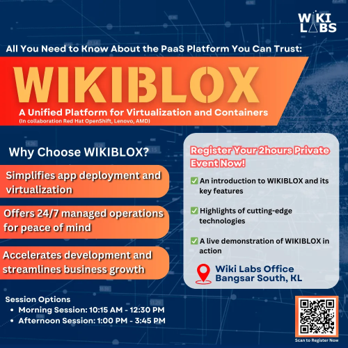
WikiBlox by Wiki Labs Sdn Bhd is engineered on an enterprise-grade architecture that integrates Red Hat OpenShift with Lenovo infrastructure powered by AMD EPYC processors, all operated within Malaysia. The platform unifies virtual-machine and container workloads under managed operations with built-in governance, security, and compliance aligned to Malaysian enterprise standards.
A recent local deployment within the financial services sector demonstrated significantly faster provisioning and measurable cost efficiencies compared with traditional virtualisation environments. For organisations exploring VMware alternatives, WikiBlox distinguishes itself through local support, regulatory alignment, and optimisation for hybrid-cloud and container workloads.
How Wiki Labs Helps Manage Virtualisation Costs
Wiki Labs provides full-lifecycle services for enterprise virtualisation — from assessing existing VMware environments to designing migration frameworks and optimising operations post-deployment.
Through cost-transparency analysis, predictable licensing models, and Malaysia-based support, Wiki Labs helps organisations identify and reduce hidden expenses associated with legacy systems. Its consultants offer clear insights into the total cost of ownership (TCO) across leading VMware alternatives, ensuring each client selects the most cost-effective and scalable approach for long-term growth.
With deep local expertise and platform-agnostic hardware integration, Wiki Labs enables Malaysian enterprises to achieve operational clarity and sustainable cost efficiency in their modernisation journey.
Ready to Move Forward with Modern VMware Alternatives?
WikiBlox isn’t just another platform. It’s your all-in-one foundation for Malaysia’s enterprise IT future.
👉 Schedule a free consultation with Wiki Labs experts today to see how WikiBlox can power your transformation.
Disclaimer:
The information in this article is provided for general informational purposes only. All product names, trademarks, and registered trademarks are the property of their respective owners. References to third-party technologies such as VMware, Red Hat, Lenovo, AMD, and others are made solely to describe compatibility or comparison context and do not imply any endorsement or affiliation.
Wiki Labs Sdn Bhd makes reasonable efforts to ensure the accuracy of information at the time of publication; however, readers are encouraged to verify technical details and licensing information directly with the respective vendors.
